
By Chance, owner of Southern Gutters FL · Published · Last updated
Key takeaways
- Seamless gutters are roll-formed on site, so a straight run has no joints between its corners and end caps.
- Most sectional gutter leaks start at the joints, where sealant breaks down under Florida sun and daily heat swings.
- A one-piece run is stiffer, hangs straighter and holds its slope toward the downspout better over the years.
- Seamless aluminum suits nearly every South Florida house; short sectional pieces still have a place on sheds and quick patches.
- Our installations carry a 3-year workmanship warranty and a 20-year materials warranty.
Seamless gutters are worth it for most South Florida homes because each run is formed on site as one continuous piece, so the joints where sectional gutters leak simply are not there. That means fewer drips at the fascia, less debris snagging inside the trough, straighter lines and far less resealing over the years.
If you have ever stood under a dripping gutter joint during an afternoon storm, you already know half the answer to why seamless gutters matter. A gutter is only as watertight as its weakest connection, and sectional systems are built from a lot of connections. Seamless gutters remove most of them by forming each run as one continuous piece of aluminum, cut to the length of your roofline.
Seamless installation is the work Southern Gutters FL is best known for. Our crews bring a roll-forming machine to the house, feed it a coil of pre-painted aluminum, and make the gutter right there in the driveway. This guide replaces our older “Why Seamless Gutters?” page and covers how seamless is made, how it stacks up against sectional, and when each one makes sense.
How seamless aluminum gutters are made in your driveway
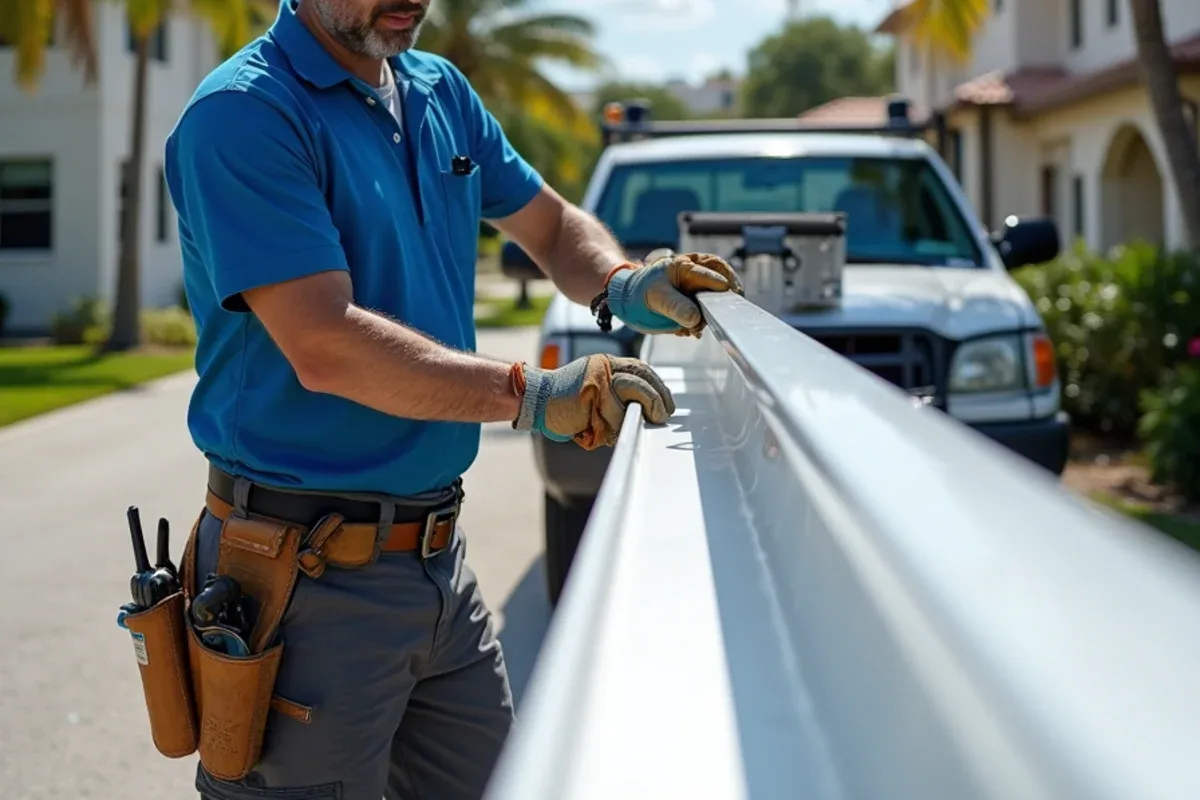
A seamless gutter starts life as a flat coil of painted aluminum. The coil runs through a gutter machine carried on our truck or trailer, and a set of rollers bends it into the finished profile as it feeds out the far end. The operator cuts it at the length measured on your house, so a 38-foot eave gets a 38-foot gutter instead of four pieces joined together.
The only joints left are the ones a gutter physically needs: miters where two runs turn a corner, end caps, and the outlets where downspouts drop. Because there are so few of them, each one gets proper attention with rivets and sealant. On a typical one-story ranch house that can mean a handful of joints in total instead of dozens.
Why forming on site matters
Measuring and forming on the same day means the length is right the first time, with no long sections bouncing around in a truck bed and getting kinked on the way. Any cut edge that would otherwise be bare metal gets painted so it weathers like the rest of the gutter.
Seamless vs. sectional gutters, side by side
Sectional gutters are sold in pre-cut lengths at home centers. They are joined with snap-on connectors and sealant, or overlapped and riveted, and they are easy to carry home in a car. That convenience is exactly why they turn up on so many do-it-yourself jobs. The cost shows up later, in the number of seams and in how those seams age.
| Factor | Seamless aluminum | Sectional |
|---|---|---|
| Joints on a straight run | None between corners and end caps | One at every section, often every 10 feet |
| Typical leak points | Corner miters and outlets, if poorly sealed | Every connector and lap joint |
| Fit to the house | Formed to the exact length of each eave | Pieced together and trimmed to fit |
| Look from the street | Clean, unbroken line | Visible joints and connector bands |
| Who installs it | Crew with a gutter machine | Often a homeowner project |
| Where it fits best | Whole-house installs and replacements | Sheds, small porches, short patches |
Neither style changes how much water a gutter can carry. Capacity comes from the profile size and how many downspouts drain the run. What seamless changes is the number of places the system can fail.
Why do sectional gutters leak at the joints?
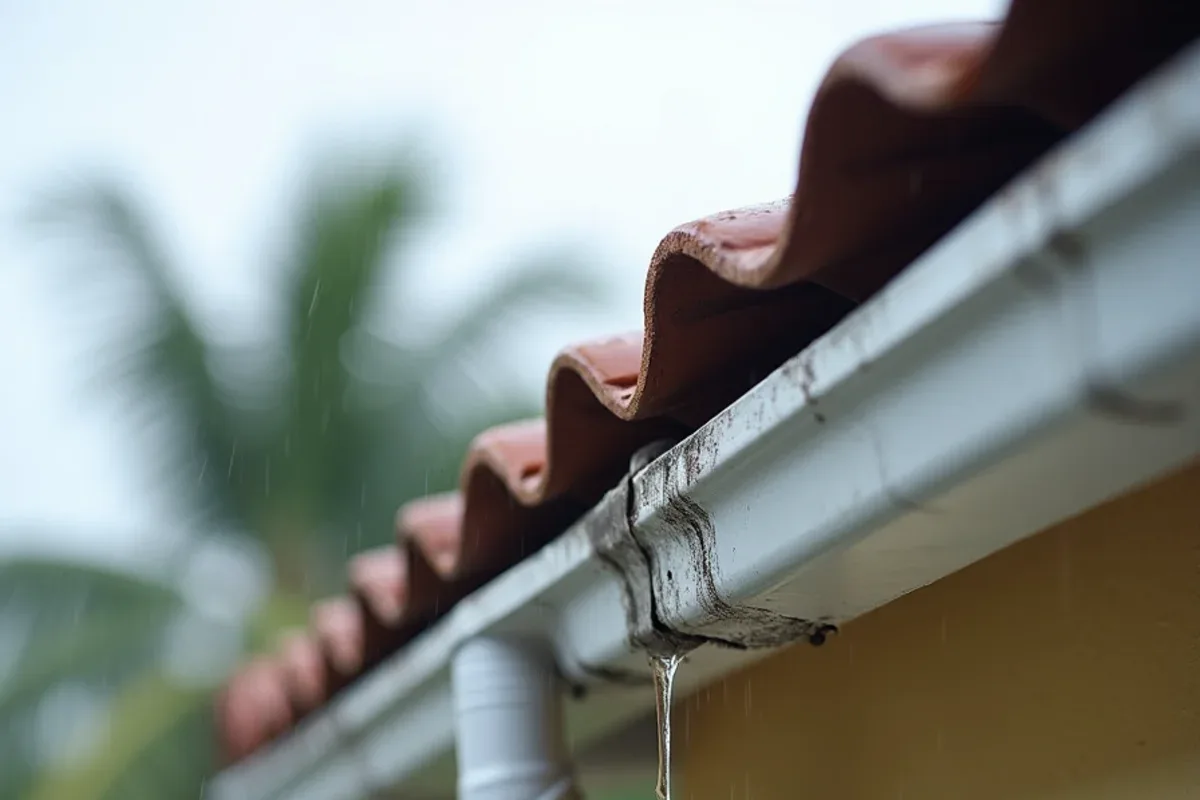
Every connection in a sectional system depends on a bead of sealant to hold water in, and in South Florida that sealant has a rough job. The metal at the roof edge bakes in midday sun, then cools fast when a cloudburst rolls in, and that cycle repeats almost daily from May through October. Aluminum grows and shrinks a little with each swing, and the sealant at every joint flexes with it until it cracks or peels away.
Once a joint opens, water drips at the seam, creeps behind the gutter and soaks the fascia board. Connectors also leave a small ridge inside the trough, so black olive leaves and palm seeds snag there and pile up at the very spot that is already weak. It is a pattern we find again and again on older sectional systems under heavy tree cover.
Check your own gutters
After a rain, step back to the street and look for drip marks or dark streaks on the gutter face. Stains that repeat at even intervals almost always line up with sectional joints.
Benefits of seamless gutters in Florida weather
- Fewer leak points. With no joints along the run, the places that can fail shrink to corners, end caps and outlets.
- Less debris snagging. A smooth trough has no inside ridges to catch leaves, pods and roof grit.
- Straighter lines. One continuous piece resists twisting between hangers and keeps its fall toward the outlet.
- Color choice. Pre-painted coil comes in a wide range of colors to match trim, stucco or a community palette.
- Less upkeep. No resealing joints every few years; routine cleaning is the main chore.
Hardware matters as much as the gutter. On our seamless gutter installation jobs, each run hangs on hidden hangers fastened into the fascia with stainless-steel screws, which stand up to humidity and salt air far better than plain zinc-plated steel. A perfect run on rusting fasteners will still sag in a few years, so we treat the screws as part of the system rather than an afterthought.

Is sectional ever the better choice?
We are not purists about it. A short sectional piece can be a reasonable fix on a tool shed, a carport or a small porch roof where the run is only a few feet long and nobody is studying it from the street. And if one length of an existing seamless system gets crushed by a falling limb, replacing just that run usually makes more sense than redoing the house.
Where sectional falls short is on the main house. If your current gutters are sectional and the joints are failing in several places, resealing them typically buys a season or two. That is usually the point where a gutter replacement in seamless aluminum costs less over the long run than chasing leaks one joint at a time. If a repair is the right call instead, we will say so.
What we find when old sectional gutters come down
Tear-off day tells the story of a sectional system better than any brochure. Behind the joints we usually find a matching stripe of dark, softened fascia, because years of slow drips landed in the same spot every storm. Many runs carry three or four generations of repair: a connector, then silicone over the connector, then roofing cement over the silicone, each layer trapping more grit.
Fasteners are the other giveaway. Older sectional jobs were often hung with spikes and ferrules or plated screws, and in our humid air those rust, loosen and let the run roll forward. A gutter that has rolled even slightly spills over the back edge in a downpour, which is why we probe the fascia before a single new hanger goes in.
The honest downsides of seamless
- A damaged run is replaced whole. If a limb crushes the middle of a long seamless run, there is no single section to swap; the piece between corners gets re-formed.
- It is not a weekend project. Seamless needs a roll-forming machine and a crew, so it is not something you pick up at a home center.
- Long eaves still need planning. On very long runs we often drop a downspout near the middle and pitch the gutter both ways, so water does not travel the full length.
- Corners still need care. Miters and outlets are the joints that remain, and a sloppy miter leaks on a seamless system just as fast as on a sectional one.
None of these outweigh the gains on a main house, but you should hear them before you sign anything. We also check whether the current size keeps up; if clean gutters still overflow in summer storms, the profile may need to go up, which our gutter sizing guide walks through.
What a seamless installation looks like with our crew
- Free estimate: we measure every eave, note roof type and pitch, and mark where downspouts should drop.
- A written quote that spells out gutter size, color, downspout count and any fascia work.
- Old gutters come down and the fascia gets probed for soft or rotted wood before anything new goes up.
- Gutters are formed on site, cut to length, mitered at corners and hung with a gentle slope toward each outlet.
- Downspouts go up and discharge away from the foundation; the crew cleans up and hauls off the old metal.
- A follow-up call after the job to confirm everything drains the way it should.
We put up seamless systems on block ranch homes a few streets from our shop in North Lauderdale and on larger tile-roof houses in Boca Raton, and the routine never changes: measure, form, hang, then run water through it before we leave. Every install is covered by the warranty above.
Is seamless the right move for your home?
For the main roofline of nearly any South Florida house, seamless aluminum is the better long-term choice: fewer joints to fail, a cleaner line from the street and hardware that holds up to humidity. Sectional pieces still earn a place on a shed or a quick patch, and a sound sectional system with one bad joint may only need a repair.
If your gutters drip at every seam or the fascia behind them is going soft, call Southern Gutters FL at (855) 633-0442 for a free estimate. We measure every eave, show you what we found and put the scope in writing before any work starts.
Questions about why seamless gutters
Are seamless gutters really seamless?
Along each straight run, yes. The gutter is one continuous piece from corner to corner, or corner to end cap. Joints remain only where they cannot be avoided: inside and outside corners, end caps and downspout outlets. A few well-sealed joints are much easier to keep watertight than one every section.
How long do seamless aluminum gutters last in South Florida?
With sound fascia, stainless hardware and regular cleaning, seamless aluminum gutters commonly last for decades. What shortens their life here is rarely the aluminum itself; it is troughs left full of wet debris, storm damage and corroded fasteners. Our installs carry a 20-year materials warranty.
Can seamless gutters go on a tile roof?
Yes. On barrel and flat tile roofs we hang the gutter from the fascia and avoid walking on or lifting tiles wherever possible. Tile sheds water quickly, so we often suggest a larger profile and well-placed downspouts to keep up with summer downpours.
What are the disadvantages of seamless gutters?
The drawbacks are practical rather than about performance. Seamless gutters need a professional crew and an on-site roll-forming machine, so they cannot be bought off the shelf, and if one run is badly damaged the whole run between corners is replaced instead of a single section. Corner miters and outlets still need careful sealing. For most homes those trade-offs are small next to having far fewer joints that can leak.
Services mentioned in this guide
Seamless Gutter Installation
Aluminum gutters roll-formed on site to each wall’s length, hung on stainless hardware, with a 3-year/20-year warranty.
Learn moreGutter Replacement
Rusted, leaking or undersized gutters swapped for seamless aluminum, with old runs hauled off and fascia checked first.
Learn moreServing North Lauderdale, Boca Raton and the rest of South Florida.