
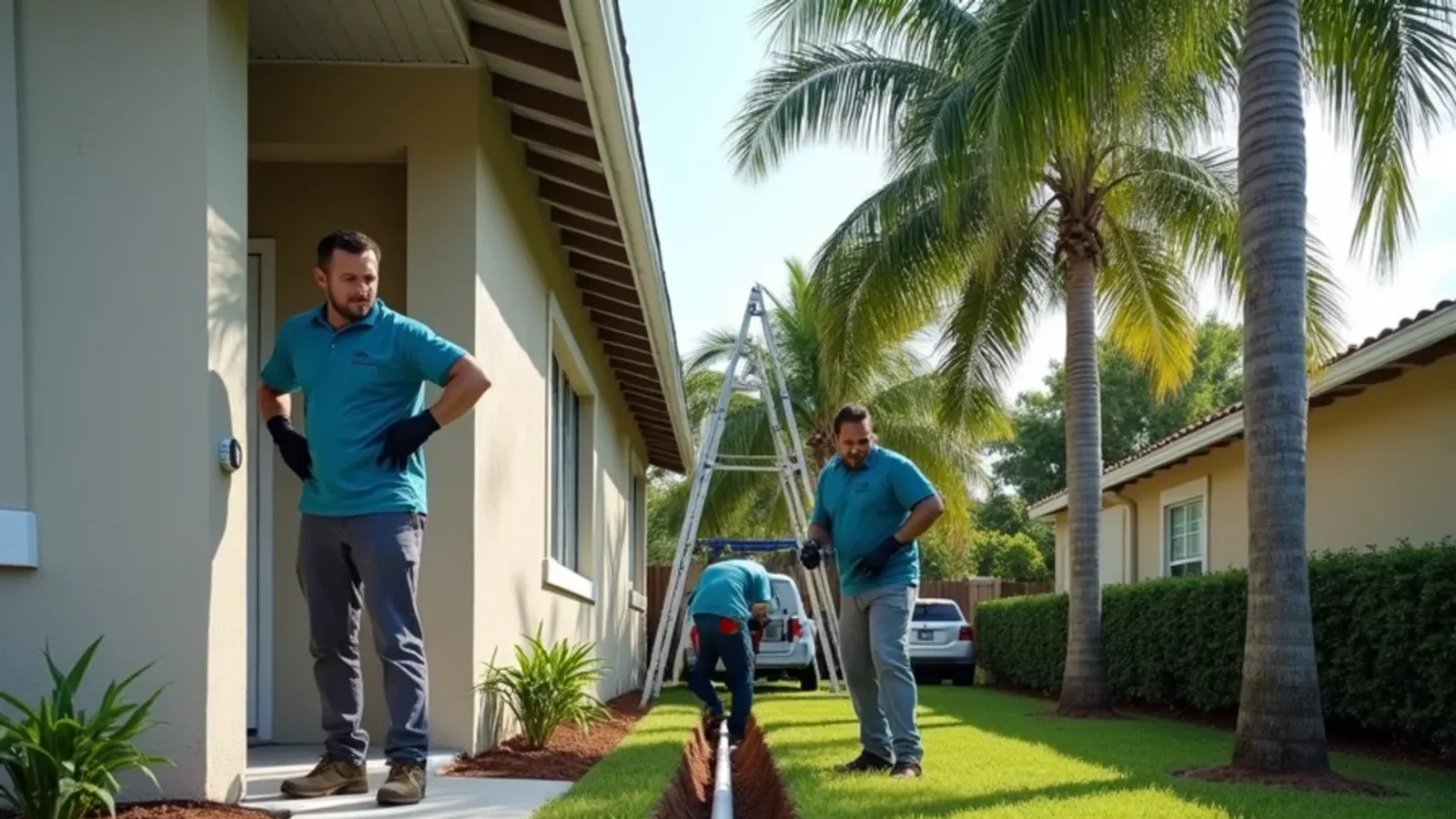
By Chance, owner of Southern Gutters FL · Published · Last updated
Key takeaways
- Total pipe length and what the trench has to cross, such as pavers, driveways and roots, drive most of the price.
- Where the water ends up, whether a pop-up emitter, swale or daylight outlet, changes both cost and how well the system works.
- A high water table limits how deep and how far a line can run, so slope and outlet height matter more here than in drier states.
- A written quote should list each downspout connected, pipe type, discharge point, utility locate and lawn restoration.
Underground downspout drainage cost is set by how far the water has to travel, what the trench crosses, how many downspouts tie in and where the water is released. Pavers, driveways, roots and a high water table add work; a short run through open sod to a nearby swale keeps the quote lean.
The easiest way to understand underground downspout drainage cost is to follow a raindrop. It leaves the gutter, drops through the downspout, turns into a buried pipe, travels across the yard and comes back out somewhere it can soak in or run off safely. Every foot of that trip, and every obstacle along it, shows up on the quote.
Buried downspouts are one of the jobs our customers mention most in reviews, so we quote a lot of them. This guide walks the route from roofline to discharge point, explains what raises and lowers the price at each stage, and covers the South Florida quirks, like sandy soil and water that sits just below the lawn, that a northern how-to will not mention.
Follow the water: the four stages you are paying for
Every underground downspout drainage job has the same four stages, even if the yard looks nothing like your neighbor's.
- Connection. An adapter joins the bottom of the downspout to the buried pipe, often with a cleanout or debris filter so the line can be serviced.
- Pipe run. A trench is cut, the pipe is laid with continuous fall toward the outlet, and joints are sealed.
- Discharge. The water exits through a pop-up emitter, into a swale, to a daylight outlet on a slope or, less often, into a dry well.
- Restoration. Soil is backfilled and compacted, and sod, mulch or pavers are put back.
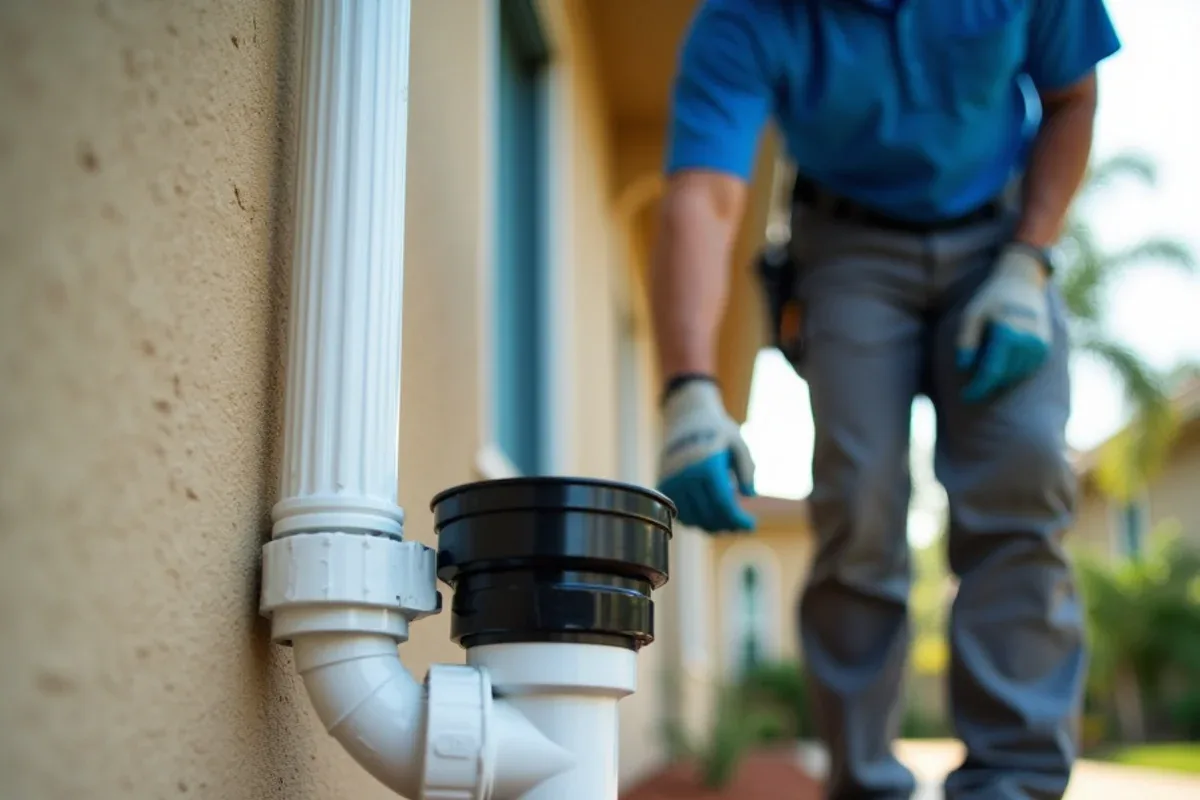
Buried downspout cost drivers, from trench to emitter
| Factor | Raises the price when | Lowers the price when |
|---|---|---|
| Total pipe length | Lines run far across the yard to reach a swale or low spot | A good discharge point sits close to the house |
| Number of downspouts | Several downspouts each need their own line | Downspouts can tie into a shared trunk line |
| Surface to cross | The route goes under pavers, a concrete walk or a driveway | The route is open lawn or planting bed |
| Roots and obstructions | Large tree roots, irrigation lines or old rubble are in the path | Clean sandy soil |
| Pipe type | Smooth-wall PVC with glued fittings is specified | A short, simple run suits flexible pipe |
| Discharge method | A dry well or multiple emitters are needed | Water can daylight onto a slope or swale |
| Restoration | Sod, decorative stone or pavers must be lifted and reset | Planting beds that only need mulch |
| Downspout condition | Downspouts are crushed, undersized or must be relocated first | Existing 3x4 downspouts are sound and in the right spots |
The biggest single driver is usually what the trench has to go through. Open sod is quick to cut and restore. Pavers have to be lifted, numbered and reset on a compacted base, and crossing under a concrete driveway takes boring equipment or a careful sleeve.
Pop-up emitter cost versus a swale or daylight outlet
A pop-up emitter is a small cap set flush with the lawn that lifts when water pushes up and drops closed when flow stops. It is neat and mower-friendly, and the emitter itself is an inexpensive part. The cost comes from getting the pipe to the right spot with enough fall.
Discharging to a front swale is common in South Florida neighborhoods built with roadside swales for stormwater. Those swales usually sit in the public right-of-way, so rules about what you can pipe into them vary by city. Daylighting onto a natural slope is often the simplest outlet of all when the lot has one.
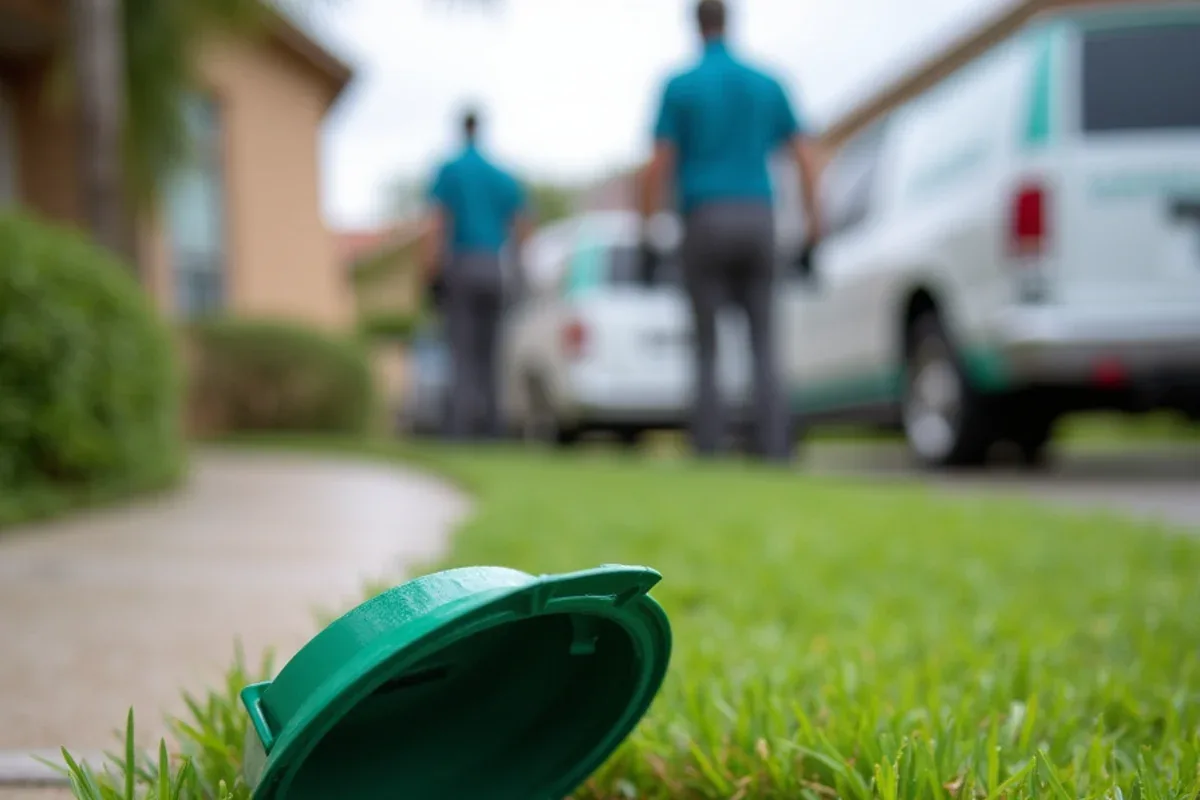
Where water must not go
Buried downspouts should never discharge onto a neighbor's lot, into a septic drain field or into a sanitary sewer cleanout. A good installer will walk the property line with you before choosing an outlet.
French drain vs underground downspout: different jobs, different budgets
People often price these together, but they solve different problems. An underground downspout carries roof water in a closed pipe from point A to point B. A French drain is a gravel trench with perforated pipe that collects groundwater and surface water along its length.
- Choose buried downspouts when the problem is roof water dumping at the foundation, washing out mulch or pooling on a walkway.
- Consider a French drain when the yard itself stays soggy after rain even where no downspout empties.
- Cost difference: French drains generally involve more excavation, filter fabric and gravel, so for the same length they tend to cost more than a solid downspout line.
Our overview of downspouts on a high water table explains why some soggy yards need grading or a drainage specialist rather than more pipe.
Long runs and big lots in Davie and Southwest Ranches
On the larger, more rural lots found in parts of Davie and across Southwest Ranches, the nearest good place to release water can be well away from the house. Longer runs mean more pipe and more trench, but open pasture-style yards are also easier to dig, so the per-foot work can be faster than on a tight suburban lot.
Western Broward also sits low, and after a few days of summer storms the water table can rise close to the surface. That limits how deep we can bury a line and still have it drain, which is why we plan shallow, steady fall and outlets that sit above where water stands.
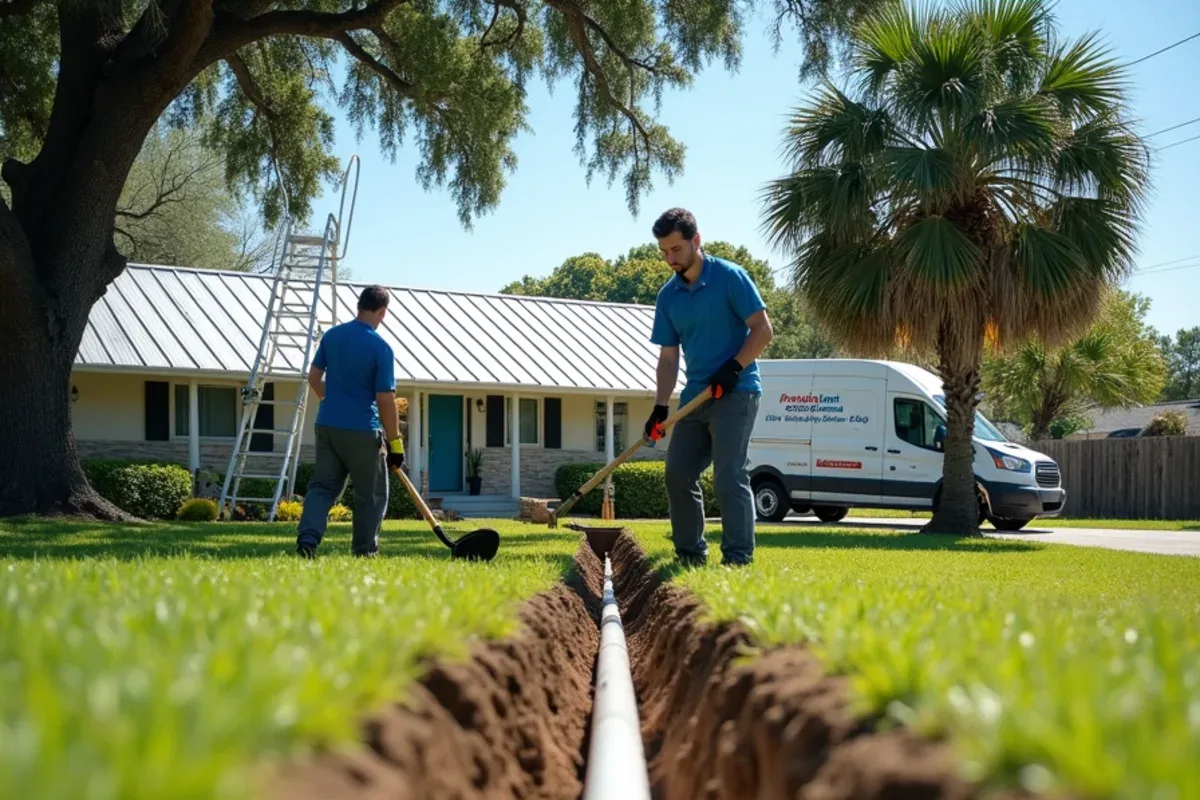
What the estimate walk reveals that a phone quote misses
Buried downspouts look simple on paper. In a South Florida yard, the surprises sit a few inches under the grass, and they are the reason we price these jobs only after walking the whole route with a probe rod and a tape.
- Sprinkler lines are everywhere. Florida law requires a Sunshine 811 locate before digging, and member utilities mark their lines, but your irrigation pipe and low-voltage landscape lighting cable are private and stay unmarked. We hand-dig where the route crosses a sprinkler zone, and the quote says how a nicked line would be handled.
- Rock changes the pace. In parts of the region, hard limestone sits close to the surface. A trench that slices through sand in one yard can need much slower work two streets over, so we probe the route instead of guessing.
- The old line may be worth saving. If you already have a buried pipe that backs up, a hose flush and hand snake from the cleanout can sometimes restore it. That is a downspout cleaning job, far smaller than a new trench.
- Not every downspout needs to go underground. A relocated drop or a longer extension can solve a puddle on a side yard. We would rather sell you the small fix that works.
When reviewers bring up our drainage work, the common thread is planning. The route, the outlet and the restoration get agreed on before a shovel goes in, which keeps the final invoice matching the written quote. For the broader picture of where roof water should end up, our downspouts and drainage page covers extensions, relocations and rain barrels as well.
What a written drainage quote should spell out
Before you compare numbers, confirm each estimate lists the following:
| Line item | Complete answer | Vague answer |
|---|---|---|
| Downspouts connected | Each one named by corner or side | "Back of house" |
| Route and length | Sketch or marked route with total run | No route shown |
| Outlet | Emitter, swale or daylight spot identified | "Away from the house" |
| Locates | Sunshine 811 ticket before trenching | Not mentioned |
| Restoration | Sod, pavers or mulch reset, named per area | "Backfill" only |
- Which downspouts are connected, by location.
- Pipe type and diameter, and whether there is a cleanout at each downspout.
- The discharge method and its exact spot on the property.
- How surfaces will be restored: sod, mulch, pavers, concrete.
- Whether underground utilities will be located through Sunshine 811, Florida's call-before-you-dig service, before trenching.
- Whether the gutters and downspouts will be cleaned first, since a buried line fed by a dirty gutter clogs fast.
Red flags
Be cautious of a quote that runs every downspout into one emitter a few feet from the foundation, that ignores slope, or that leaves no way to clean the line. When you are ready, ask us for a free written estimate; we will walk the route with you and mark where each line will go.
Budgeting for a buried downspout line
The price of a buried line follows the route: length, surfaces crossed, rock and roots, the outlet and the cleanup afterward. A quote that names each of those, along with every downspout tied in, is one you can trust and compare.
We walk the yard with you, mark the route and put every line item in writing before any digging starts. Call Southern Gutters FL at (855) 633-0442 for a free drainage estimate.
Questions about underground downspout drainage cost
How long do buried downspout lines last?
Properly sloped solid pipe with cleanouts can last for many years. Most failures come from clogging, crushed pipe under vehicles or roots, not from the pipe wearing out. Keeping the gutters above clean is the best way to protect the buried line.
Can you connect underground drainage to my existing downspouts?
Usually, if the downspouts are sound, properly sized and positioned well. If one is crushed or empties in an awkward spot, we may replace or relocate it first, and that appears as its own line on the quote.
Do I need a permit for underground downspout drainage?
Often not for a line that stays on your own lot, but rules vary by city. Piping into a roadside swale can involve the public right-of-way, which some cities regulate, and HOAs may want to review work that changes landscaping or front-yard grading. Ask your city and association before work starts, and make sure whoever digs calls Sunshine 811 first.
Is it cheaper to clear an old buried line than install a new one?
Usually, yes, if the pipe is intact. A clogged line can often be flushed and snaked from the cleanout or the downspout adapter. If the pipe is crushed, sags and holds water, or has no fall, clearing only buys time, and a new run with a proper outlet is the better spend. We test before recommending either.
Services mentioned in this guide
Underground Downspout Drainage
Downspouts piped underground to pop-up emitters or the swale, pitched to work with a high water table.
Learn moreDownspouts & Drainage
Downspouts sized, placed and routed so roof water clears your slab, patio and the neighbor's yard.
Learn moreDownspout Cleaning & Flushing
Clogged downspouts flushed, snaked and flow-tested, including buried lines and frog-packed elbows.
Learn moreServing Davie, Southwest Ranches and the rest of South Florida.