
By Chance, owner of Southern Gutters FL · Published · Last updated
Key takeaways
- Most South Florida commercial roofs need drainage cleaned at least twice a year; tree-lined sites and flat roofs with interior drains often need three or four visits.
- Schedule one visit before the rainy season starts in May and one after the peak of hurricane season.
- Add a post-storm check after any named storm or major wind event.
- The contract should list every drain point, the reporting format, access rules and how repairs are approved.
- Recurring overflow at the same spot means the schedule or the system needs to change.
Most South Florida commercial properties should have gutters and roof drains cleaned at least twice a year, in April or early May and again in November or December, plus a check after any named storm. Plazas and campuses under heavy trees, and restaurant roofs near grease exhaust, usually need three or four visits.
A homeowner can get away with noticing a clogged gutter when it overflows. A plaza manager cannot. On a commercial building, a blocked roof drain means water through a tenant’s ceiling tiles, a slip hazard at the storefront, or ponding that sits on the roof membrane for days. The cost lands on the owner, the tenant and the insurer all at once.
A written commercial gutter cleaning schedule prevents most of that. This guide gives a starting frequency by property type, shows how to build the year around South Florida’s rainy and hurricane seasons, and lists what to put in the contract so the schedule actually happens.
Starting frequencies by property type
Treat these as starting points for a site walk, not fixed rules. Tree cover, roof type and how close the building sits to the coast all move the number.
| Property type | Typical drainage | Open site, few trees | Moderate trees | Heavy trees or palms |
|---|---|---|---|---|
| Strip plaza | Flat roof, scuppers, front canopy gutters | 2 visits a year | 3 visits | 4 visits |
| Warehouse or flex space | Low-slope metal roof, large gutters, interior drains | 2 visits | 2–3 visits | 3–4 visits |
| Church or school | Mixed pitched and flat sections, long gutter runs | 2 visits | 3 visits | 4 visits |
| Restaurant pad | Flat roof, grease exhaust near drains | 3 visits | 3–4 visits | 4 visits |
| Office building | Flat roof, interior drains, parapet scuppers | 2 visits | 2–3 visits | 3 visits |
Restaurants rank high regardless of trees because kitchen exhaust can deposit grease on the roof, which binds with debris and slows drains. Keep the exhaust contractor and the drainage contractor talking.
Plaza maintenance: canopies, scuppers and storefronts
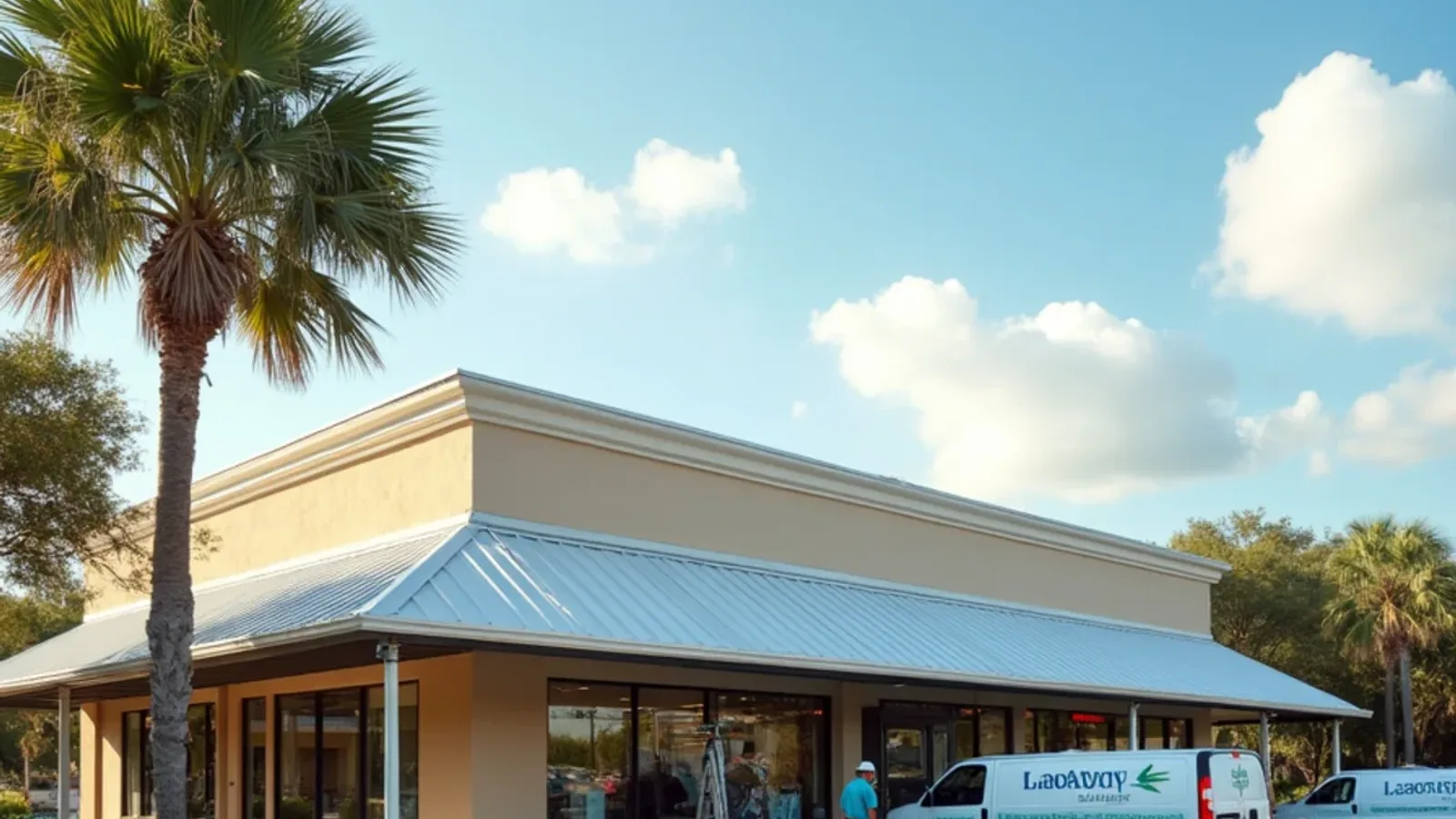
Strip centers usually combine a flat main roof that drains through scuppers or interior drains with a sloped front canopy that has its own gutters over the walkway. The canopy gutters are the ones customers see fail: water sheeting onto the sidewalk, staining the facade and pooling at the door.
Landscape islands with black olive, oak or royal palms are common in plaza parking lots, and wind carries their leaves and fronds straight onto the canopy. Sites like that around Pompano Beach and other busy Broward corridors often need the canopy gutters cleared more often than the main roof.
Warehouse gutter cleaning and roof drain cleaning
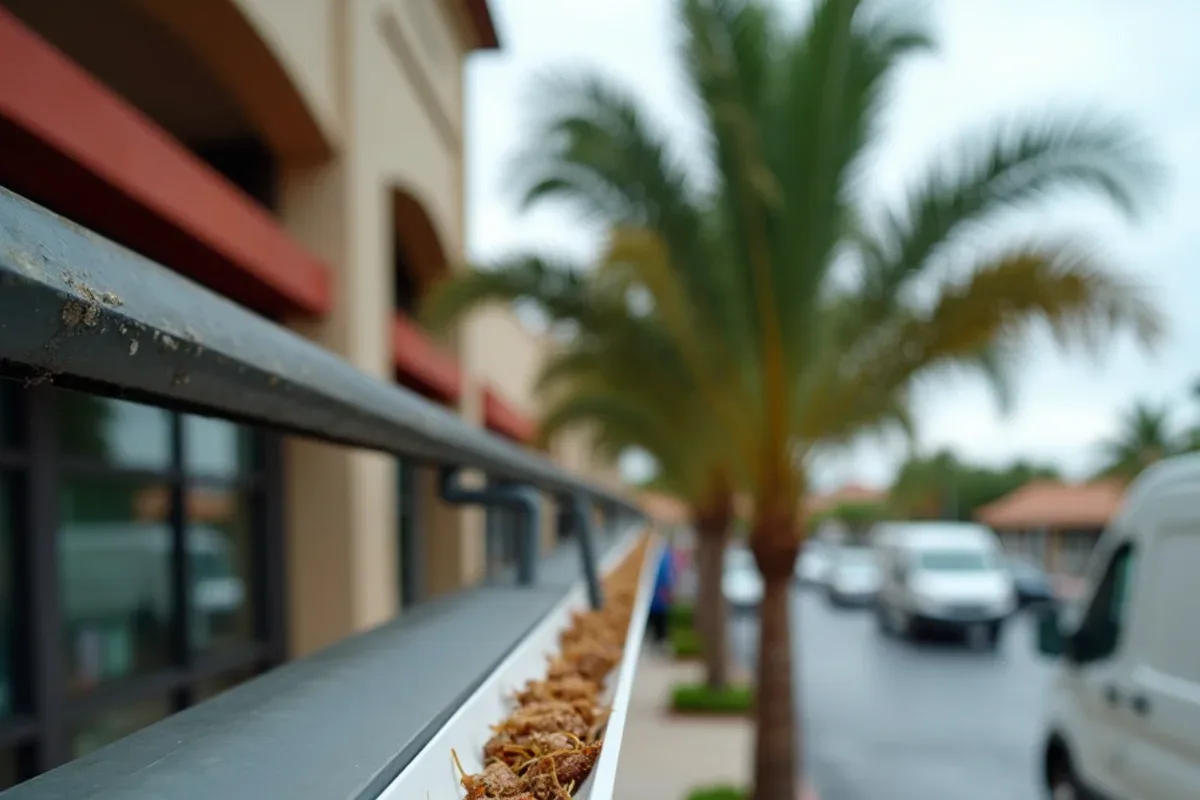
Warehouses and flex buildings in industrial parks tend to have big, simple roofs: long low-slope metal or membrane surfaces draining to oversized eave gutters or a handful of interior drains. Each drain handles a lot of square footage, so a single blocked strainer can back water across a large area quickly.
Debris here is less about leaves and more about wind-blown trash, sand, roofing fasteners, bird nesting and the occasional pallet wrap. Industrial areas across Miami-Dade County and western Broward see plenty of it. Interior drains need their strainer domes cleared and the drain throat checked, the same routine as our flat roof scupper cleaning; eave gutters need their outlets confirmed open from top to bottom.

Churches, schools and campuses with mixed roofs
Houses of worship and school campuses are the hardest to schedule because they are rarely one roof. A sanctuary with a steep pitched roof and long gutter runs might connect to a flat-roofed fellowship hall, a covered walkway and a modular classroom, each draining differently. Many sit on large lots with mature oaks and mahogany trees that were there before the buildings.
Two practical points for these sites. First, plan visits around the calendar the building actually keeps: weekday mornings for a church, school breaks or weekends for classrooms. Second, pay attention to covered walkways. Their small gutters often get skipped because they look minor, yet they sit exactly where children and older members walk on rainy days.
Building a property maintenance schedule around the seasons
South Florida has a clear wet season from roughly May through October, overlapping hurricane season from June 1 to November 30. A workable calendar looks like this:
- April or early May: full cleaning before the afternoon storms begin. Note any damage for repair before June.
- July or August (for three- and four-visit sites): mid-season clear-out, especially under trees that drop through summer.
- After any named storm: a post-storm check of drains, gutters and downspouts, scheduled as soon as it is safe and the calendar allows.
- November or December: cleaning after the peak of hurricane season and fall leaf drop, with a condition report for the next budget year.
Budget timing
A December report listing deficiencies gives the owner time to plan repairs before the next rainy season instead of reacting during it.
What to put in a commercial gutter maintenance contract
Our commercial gutter cleaning agreements are built around the property, not a generic template. Whichever contractor you use, insist on these items:
- A site map with every gutter run, drain, scupper and downspout numbered.
- Visit months fixed in writing, with the post-storm option spelled out.
- Access details: roof hatch or ladder location, keys, alarm codes handled by the manager, and tenant notice.
- Working-hours rules, such as before opening or after close for restaurants and retail.
- A certificate of insurance naming the owner or management company, renewed on time.
- A report after every visit with photos at each drain point and a list of deficiencies.
- A clear rule that repairs need a written quote and approval before work starts.

What overflow scuppers and drains tell us on commercial roofs
On a flat commercial roof, the overflow scupper is a warning light. Code-built roofs with parapets have secondary drains or scuppers set above the primary drains, and building officials treat water pouring from that secondary opening as a sign the primary drain is blocked. If a tenant mentions a waterfall from a high scupper during storms, that roof needs attention before the next rain, not at the next scheduled visit.
The reason is weight. Roof sections are designed to carry the water that would collect if the primary drains clog, up to the level of the overflow. A roof that spends every storm at that level is living on its safety margin. Roofing researchers have also measured how debris on strainers and in scuppers cuts their flow, so a half-covered strainer is not half a problem.
The other pattern we see is debris from other trades. New rooftop units, sign installs and tenant build-outs leave screws, insulation scraps and shrink wrap near drains. After any rooftop work, ask the contractor to clear the drains, or add a visit to the schedule.
How a commercial drainage visit runs
- Check in with the manager, confirm access and post any tenant notice.
- Walk the roof first and photograph each numbered drain, scupper and gutter outlet before touching it.
- Clear strainers, scupper throats, gutter troughs and canopy runs, bagging debris rather than dropping it to the lot.
- Flush each downspout and interior drain until water runs freely at the discharge point.
- Photograph again, list deficiencies and send the report so repairs can be quoted separately.
The trade-off managers weigh is guards versus visits. Gutter guards on canopy runs under black olives can stretch the time between cleanings, but they still need servicing, and they do nothing for interior drains on the main roof. We usually recommend them on the worst two or three runs, not the whole site.
Signs your commercial gutter maintenance schedule is too thin
Watch for these between visits. Any of them means adding a visit, adding guards on the worst runs, or fixing a system problem:
- Tenants report drips or ceiling stains during storms.
- Water sheets off the canopy at the same spot every rain.
- Ponding on the roof that is still there two days after rain.
- Downspout outlets at grade are dry during a storm while the gutter above overflows.
- Staining down the facade below scuppers or gutter seams.
If overflow keeps returning right after a cleaning, the gutters or downspouts may simply be undersized for the roof area. That is a design question, not a frequency one.
Putting your commercial drainage calendar in writing
A commercial gutter cleaning schedule works when it is specific: a visit before the wet season, one after hurricane season, extra visits where trees or kitchen exhaust demand them, and a post-storm check written into the contract. Pair that with a numbered drain map and photo reports, and leaks stop being surprises.
To set up a schedule for a plaza, warehouse, church or school, call Southern Gutters FL for a free estimate. We will walk the roof, number the drains and put the visit months in writing. Our commercial gutter services page covers the rest of what we handle on business properties.
Questions about commercial gutter cleaning schedule
Can commercial gutter cleaning be done after business hours?
Often, yes. Early-morning or after-close visits are common for restaurants and retail plazas. Roof access, lighting and safety conditions decide what is practical, so build working hours into the contract.
Who is responsible for gutters in a multi-tenant plaza?
Usually the landlord or association, under the lease’s common-area maintenance terms, but leases vary. Check the lease and make sure one party owns the schedule so drains are not left to whoever notices first.
What does it mean when water pours out of an overflow scupper?
Usually that the primary roof drain below it is blocked or overwhelmed. Secondary scuppers sit higher than the main drains on purpose and should only run in extreme storms. If one flows during an ordinary afternoon shower, have the primary drain and strainer cleared promptly, because the roof is holding extra water weight until it is.
Should a new tenant build-out change the cleaning schedule?
Yes, at least for that year. Rooftop HVAC installs, sign work and build-outs leave fasteners, insulation and wrap near drains. Ask the trade contractor to clear the roof when they finish, and schedule a drainage visit once the work wraps up so the next storm does not find their leftovers in a strainer.
Services mentioned in this guide
Commercial Gutter Cleaning
Scheduled clearing of gutters, scuppers and roof drains on plazas, warehouses, churches and schools, with a photo log.
Learn moreFlat Roof Scupper & Gutter Cleaning
Scuppers, leader heads and flat-roof drains cleared and flood-tested before ponding water finds a seam.
Learn moreCommercial Gutter Services
Cleaning, installation and repair for plazas, warehouses, churches and associations, with insured crews and photo reports.
Learn moreServing Pompano Beach, Miami-Dade County and the rest of South Florida.