
By Chance, owner of Southern Gutters FL · Published · Last updated
Key takeaways
- Every downspout should discharge far enough from the slab that water flows away rather than pooling at the wall.
- The front swale is often the best final destination, but many cities restrict filling, paving or piping into it.
- Directing roof water onto a neighbor’s property is a common source of disputes and is restricted in many local codes.
- Pool decks and paver patios are poor discharge points; water sheets back toward the house or undermines the base.
- One house can need three different answers for three different downspouts.
Downspouts should drain onto ground that falls away from the house and keep that water moving toward a lawn low spot, the edge of the swale or the street line, several feet past the slab. They should never empty onto a neighbor’s yard, a pool deck, a paver patio or the base of a stucco wall.
Ask five neighbors where downspouts should drain and you will get five answers, most of them some version of “away from the house.” That is the right instinct, but on a typical South Florida lot “away” has limits. The side yard is eight feet wide, the back is a pool deck, the front has a swale with rules attached, and the house next door is close enough to share your runoff whether they like it or not.
This guide walks through each place roof water might end up, which ones work, which ones cause trouble, and how to decide for each corner of your house.
The one rule that applies to every downspout placement
Water should leave the downspout, land on ground that slopes away from the building, and keep moving until it reaches a place designed to hold or carry it. If any link in that chain breaks, the water stops and pools, usually right where you do not want it.
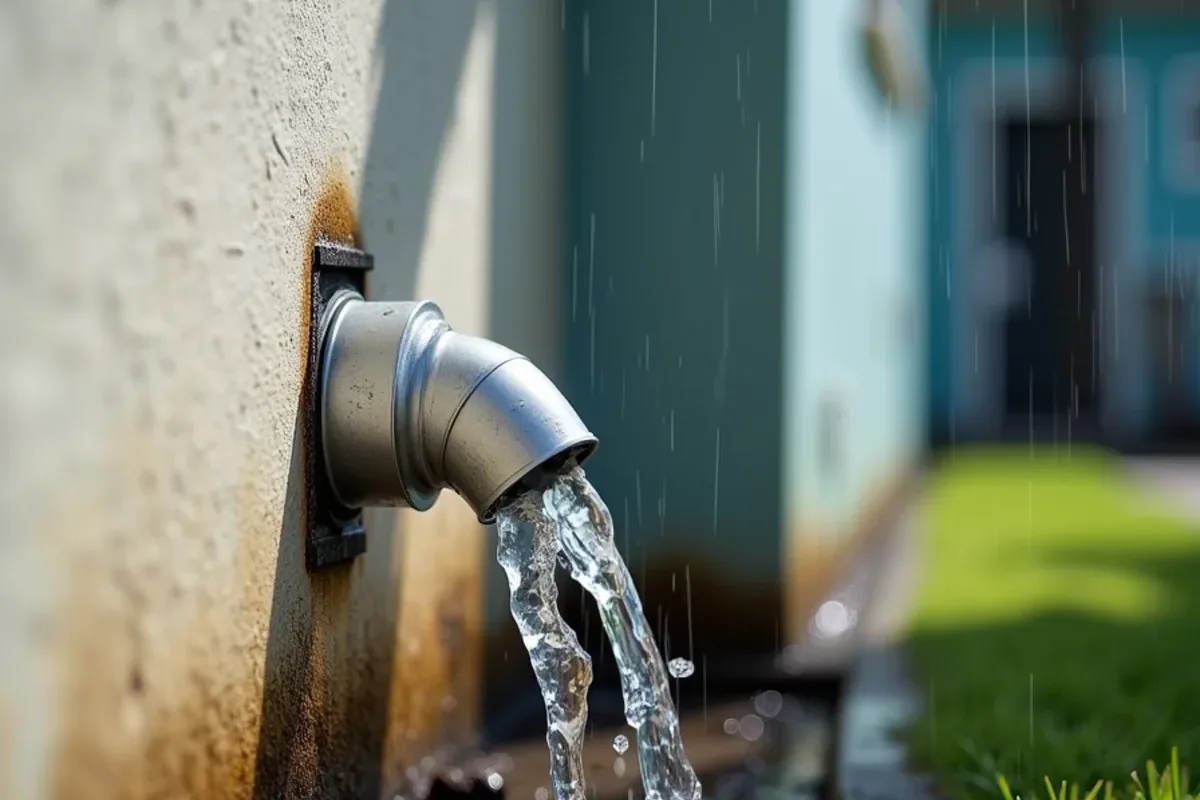
Most South Florida homes sit on concrete slabs with stucco walls that run close to grade. Water pooling near the foundation does not usually crack a slab the way it heaves basements up north, but it does stain stucco, wash out mulch and sand, invite termites and keep the base of the wall damp for days. A short elbow that dumps a roof’s worth of rain straight down at the wall is the most common mistake we see.
Each destination, rated for a South Florida lot
| Destination | Usually OK? | What to watch |
|---|---|---|
| Open lawn sloping away | Yes | Needs a few feet of extension and a splash block so sod does not wash out |
| Front swale | Often | City rules on swale work; do not block the swale or regrade it |
| Street or gutter line | Sometimes | Piping across a sidewalk or into the road edge may need permission |
| Neighbor’s yard | No | Restricted in many local codes and a frequent source of disputes |
| Pool deck or pavers | No | Sheets back to the house or washes out the sand base |
| Planting bed | With care | Fine for a light flow; a full downspout can strip mulch and soil |
| Rain barrel | Yes, with overflow | Overflow still needs a proper destination |
| Canal or lake bank | Check first | May fall under HOA, water management or city rules |
The table is a starting point. Ground conditions, roof size and how many square feet feed each downspout all change the answer.
Swale drainage: why the front strip matters
Many South Florida streets were built without curbs and storm inlets on every block. Instead, a shallow grassy dip between sidewalk and road, the swale, holds runoff and lets it soak into the sand. Older neighborhoods in places like Lauderdale Lakes and much of central Broward depend on them.
Because the swale is part of the public stormwater plan, cities often limit what owners can do there: no filling it in, no paving it over, sometimes no piping into it without approval. Running a buried line so that it daylights at the edge of your own lawn, just short of the swale, is often an acceptable middle ground. Ask your city before you trench.
Not sure who owns the swale?
In many cities the swale sits in the public right-of-way even though the homeowner mows it. Your city’s public works or engineering department can tell you what is allowed.
Can a downspout drain to the street?
Sometimes. On a lot that slopes toward the road with no swale, a downspout extension or buried line that reaches the curb line can work well. The issues are the sidewalk and the right-of-way. Cutting under a public sidewalk or poking a pipe through a curb is usually a permitted job, not a weekend project.
Coastal neighborhoods add another wrinkle. In low streets in Hollywood and other coastal cities, king tides can push water up through storm drains onto the road. A downspout aimed at a street that is already flooded during a high tide is not draining anywhere.
Two destinations to avoid: next door and the pool deck
The neighbor’s side yard
On zero-lot-line homes and tight subdivisions, a side-yard downspout can easily point at the house next door. Beyond being unneighborly, many local codes and HOA documents restrict changing drainage so that it flows onto another property. Turn the extension toward the front or back of your own lot, or route it underground to your own low point.
Pool decks and pavers
Decks are built to shed a little splash, not a roof’s worth of water. Discharge onto pavers floods the deck, washes the bedding sand out from under the edges and can carry debris into the pool. If a downspout lands on a deck now, a buried line under the pavers to a lawn outlet or a relocated downspout is usually the fix.
Picking downspout placement corner by corner
Walk the house during a heavy rain with an umbrella. For each downspout, note where the water lands and where it goes next. Then match it to a fix:
- Water pools within a couple of feet of the wall: add a downspout extension or a longer splash block.
- Extension crosses a walkway or mower path: a hinged flip-up extension or a short buried run.
- Water lands on a deck or patio: move the downspout to another corner or pipe it under the deck.
- Two downspouts flood the same low spot: split them so each has its own destination.
- Water reaches the lot line toward a neighbor: redirect toward the front or back of your own property.
Our downspouts and drainage team handles the full range, from simple extensions to buried lines. Moving a downspout to a better corner, adding one to split a heavy load or swapping a crushed section is all part of downspout installation and repair, and it is often simpler than reshaping the yard around a bad location.
What drainage calls look like from our side of the ladder
Homeowners rarely call about a downspout. They call about a dark band on the stucco a foot above the ground, a paver that rocks underfoot by the patio, or sand fanned across the driveway after a storm. When we trace those symptoms back, the trail usually ends at one downspout with the wrong destination.
Moisture at the wall matters here for a reason northern guides skip. The termite-protection section of the Florida Building Code, Residential has long required roof downspouts to discharge at least 1 foot from the sidewall, because a constantly wet slab edge helps subterranean termites. Treat that foot as the legal floor, not the goal.
Grade does the rest. Codes generally want the ground to fall about 6 inches within the first 10 feet of a foundation, or a swale sloped at least 2 percent where lots are too tight for that. Many older Broward lots have lost that fall to added mulch, sod and pavers, so water stops a few feet out even when the extension is long enough.
How we test a discharge point before changing it
- Run a hose into the gutter outlet at full flow to imitate a cloudburst on that roof section.
- Watch where the water lands, how far it travels and where it stops.
- Check the grade with a level and note mulch or sod that has built up against the wall.
- Mark obstacles in the path: walkways, AC pads, irrigation heads, the lot line.
- Pick the destination and write it on the estimate with the reason, so you can judge it yourself.
The trade-offs are real. Extensions are simple but get kicked, mowed and moved. Buried lines stay out of sight but need fall and an occasional flush. Moving the downspout is more work up front, yet on a narrow lot it is often the only answer that does not create a new wet spot somewhere else.
Giving every downspout a place to go
Good drainage is a chain: downspout, slope, destination. Lawns that fall away, swale edges and, with permission, the street line are the usual winners on a South Florida lot. Neighbors’ yards, pool decks and the foot of a stucco wall are the losers, and one house can need a different answer at every corner.
If you are not sure where your roof water ends up, ask Southern Gutters FL for a free estimate. We will walk each downspout with you, test it with a hose and put the recommended destination in writing.
Questions about where should downspouts drain
How far from the house should a downspout discharge?
Far enough that the water keeps flowing away rather than soaking back toward the slab. Many guides suggest several feet; on flat South Florida lots the slope of the ground matters more than the exact distance. If water still pools near the wall after rain, the outlet needs to move farther out.
Is it legal to send downspout water into the swale?
It depends on your city. Water flowing over the lawn into the swale is normal, but piping directly into it, filling it or paving it is often restricted. Call your city’s public works department before any work in the right-of-way.
Should a downspout connect to a French drain?
Usually not. A French drain is perforated pipe in gravel built to collect groundwater slowly, while a downspout delivers a burst of roof water and grit in minutes. Tying the two together on a South Florida lot can overload the drain and fill its gravel with sediment. We run roof water in its own solid line to a separate outlet.
Do downspout extensions actually make a difference?
Yes, when the ground beyond them slopes away. An extension that carries water four to six feet out onto falling lawn often stops staining and washouts at the wall. On a flat or back-sloped yard it just moves the puddle, and the fix becomes regrading, a buried line or a downspout in a better corner.
Services mentioned in this guide
Downspouts & Drainage
Downspouts sized, placed and routed so roof water clears your slab, patio and the neighbor's yard.
Learn moreDownspout Installation & Repair
Crushed, loose or undersized downspouts replaced, extra outlets added and straps reset tight to the wall.
Learn moreServing Lauderdale Lakes, Hollywood and the rest of South Florida.