
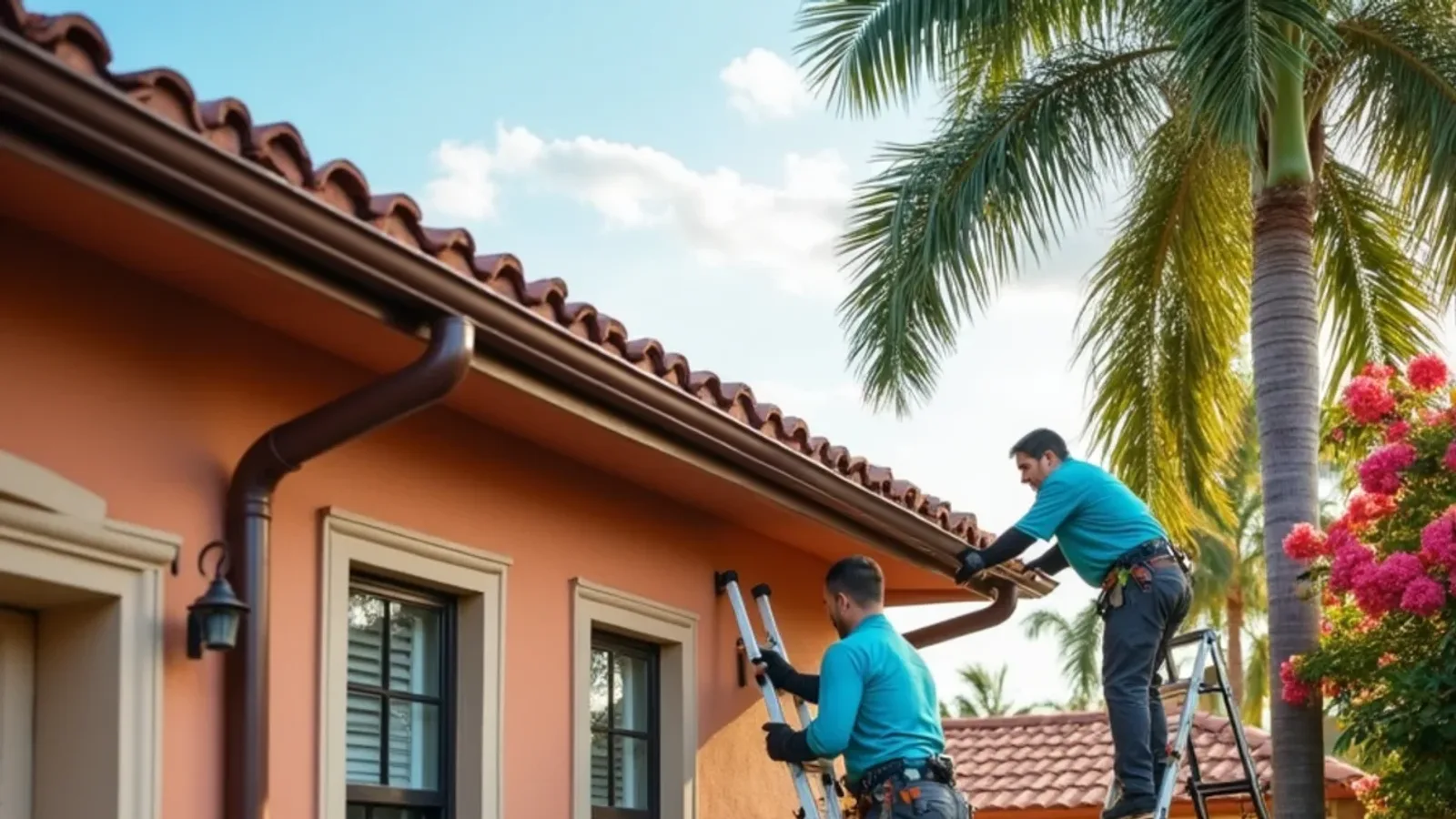
By Chance, owner of Southern Gutters FL · Published · Last updated
Key takeaways
- A K-style gutter holds more water than a half-round of the same width, which matters during summer cloudbursts.
- Half-round gutters drain more completely and suit Mediterranean Revival, Spanish and other historic home styles.
- Half-round is usually sized one step up and paired with round downspouts to match K-style capacity.
- Brackets, round downspouts and extra fitting make half-round a larger investment than K-style.
- Some owners use half-round on the street-facing sides and K-style on hidden elevations.
K-style gutters carry more water at the same width, mount cleanly on flat fascia and cost less, so they suit most South Florida homes. Half-round gutters drain more completely and look right on Mediterranean Revival, Spanish and historic houses, but they usually need to be sized one step up with round downspouts to keep up with cloudbursts.
Ask most homeowners to sketch a gutter and they draw a K-style without knowing its name: a flat back against the fascia and a front that curves like crown molding. Half-round is the older shape, a simple open semicircle that you see on century-old buildings across Europe and on 1920s homes in Coral Gables and Delray Beach. The half round vs k style gutters decision comes down to three things: how much water the roof sends, how the house is built, and what it is supposed to look like.
Neither is better in every case. On a typical South Florida home, K-style is the efficient, economical choice. On a house whose architecture predates K-style, a half-round profile can make the difference between a gutter that looks bolted on and one that looks original.
Gutter styles in brief: two shapes, two philosophies
K style gutters
The K-style profile became standard in the United States in the second half of the 20th century, and it is what most South Florida homes built since then carry. Its flat back sits tight against the fascia, so it can be hung on hidden hangers inside the trough. The ogee front hides those hangers and reads as trim from the street. Because it is easy to roll-form, K-style is the profile most commonly installed seamless on site.
Half-round gutters
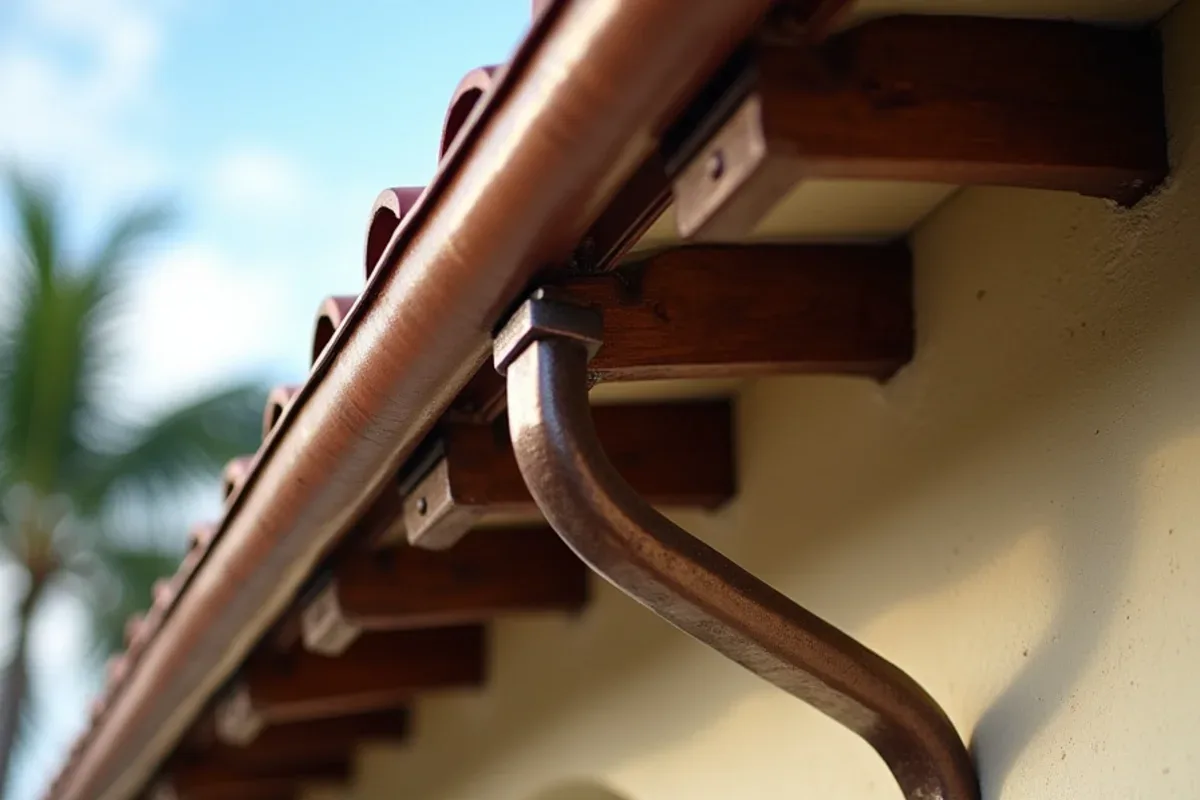
A half-round gutter is an open semicircle with a rolled bead on the front lip for stiffness. Its rounded back does not sit flat against a board, so it hangs from brackets fastened to the fascia, to rafter tails or to the roof deck. It pairs with round downspouts and drop outlets, and the brackets themselves become a visible part of the design.
Gutter profile comparison, line by line
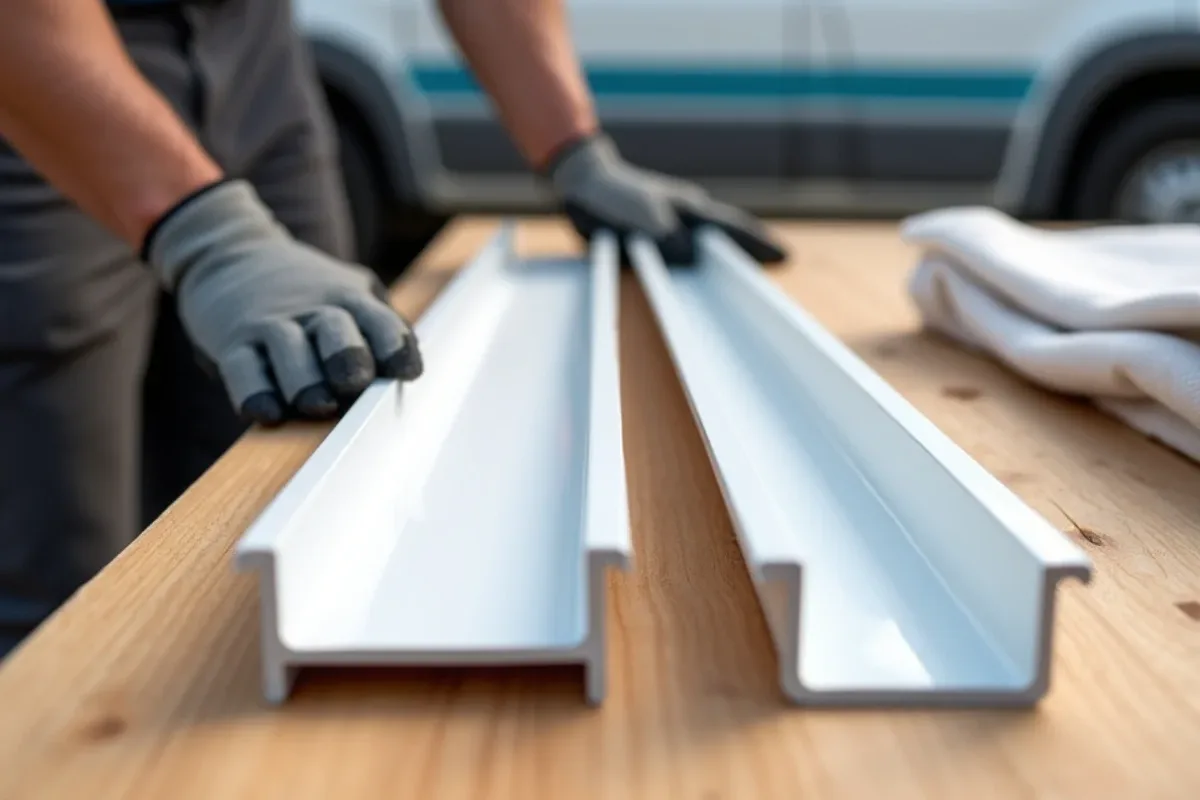
| Factor | K-style | Half-round |
|---|---|---|
| Water capacity at the same width | Higher | Lower; usually sized up a step |
| Mounting | Hidden hangers on flat fascia | Visible or concealed brackets |
| Downspouts | Rectangular, 2x3 or 3x4 | Round, commonly 3-inch or 4-inch |
| Draining between storms | Flat floor can hold a film of water | Rounded bottom drains more fully |
| Debris | Can settle in the corners of the trough | Tends to flush toward outlets |
| Look | Trim-like, blends in | Classic, reads as an architectural detail |
| Relative cost | Lower | Higher |
| Best fit | Most ranch, two-story and modern homes | Mediterranean Revival, Spanish, historic and estate homes |
If you only skim one line, make it the first. Capacity matters more in South Florida than almost anywhere else, so the profile choice always comes with a sizing decision.
Which profile carries more water in a Florida cloudburst?
Compare a 5-inch K-style and a 5-inch half-round side by side and the difference is obvious: the K-style has a flat floor and taller sides, so its cross-section is noticeably larger. In a gentle rain that does not matter. In a July thunderstorm that dumps rain in a short burst, the smaller trough fills first and spills over the bead.
The usual fix is to step up. Where a house might take 5-inch K-style, it gets 6-inch half-round, with 4-inch round downspouts on tile roofs and long runs. More outlets help too, since a round downspout of the same nominal size can move less water than a large rectangular one. Sized this way, half-round keeps up with our storms just fine.
Tile roof note
Barrel tile usually overhangs the eave. A half-round gutter needs to sit far enough out for the water leaving the tile lip to land inside the trough, which affects bracket choice and placement.
Historic home gutters: when is half-round the right call?
Half-round belongs on architecture that was designed before K-style existed. South Florida has a lot of it: the Mediterranean Revival homes of Coral Gables, laid out by George Merrick in the 1920s, and the older cottages and bungalows around downtown Delray Beach, where several historic districts protect the original character. A K-style gutter on those houses tends to look like a later addition.
Newer estate homes built in a Mediterranean or Spanish style are good candidates too, especially with barrel tile roofs, arched openings and decorative rafter tails. In locally designated historic districts, exterior changes can require city review, so ask about it early. Homes elsewhere in Miami-Dade County with that 1920s character get the same treatment.
Why K style gutters still win on most Florida homes
For a block ranch, a two-story stucco home or a townhouse in a planned community, K-style simply works better. It carries more water per inch of width, mounts cleanly to a flat fascia, comes in more colors, and is formed in one piece on site to the exact length of the eave. It also blends into the trim, which is usually what owners and HOAs want.
Contemporary homes with clean lines are another case for K-style, or for a simple box profile. A rounded gutter on a flat-roofed modern house can look out of place.

What we notice hanging half-round on South Florida houses
Bracket choice shapes the whole job. Fascia brackets screw to the face of the board and work on almost any retrofit. Strap brackets fasten to the roof deck under the roofing, which gives a cleaner look below a deep tile eave, but they really belong in a reroof schedule. Lifting set barrel tile to slide straps underneath risks cracked tile, so on an existing tile roof we usually recommend fascia brackets.
The rounded floor does shed fine grit toward the outlets, yet the brackets crossing the open top catch palm fronds and long leaves. Under black olive trees the drop outlet stays the choke point, exactly as it does on a K-style run. Where a house mixes the two profiles, we plan the change at a corner, where the eye does not follow the line, and keep the color the same on both sides.
Questions to ask before you choose half-round
- Which gutter size and round downspout diameter is quoted for each run, and how many outlets?
- Fascia brackets or strap brackets, and how far apart will they be set?
- Is each run formed in one piece or joined from lengths, and how are the joints sealed?
- Painted aluminum or copper half-round gutters, with hangers and fasteners that match the metal?
- Is the home in a locally designated historic district where exterior changes need city review?
A quote that answers all five is one you can compare fairly against any other.
Half round gutters cost: what drives the difference
Half-round costs more than K-style on the same house, and it is worth knowing why before you compare quotes. The trough itself is a more specialized product, the brackets are more numerous and more visible, round downspouts and fittings cost more, and joining lengths takes more labor. Copper half-round adds the higher metal cost and soldered joints on top of that.
Many owners split the difference: half-round on the elevations people see from the street, and K-style in a matching color on the back and sides behind fences or pool cages. Our half-round gutter installation quotes can be written either way, with each option priced by elevation so you can decide. Installs carry a 3-year workmanship and 20-year materials warranty.
Choosing the profile that fits your house
Pick K-style when capacity, cost and a gutter that disappears into the trim matter most, which describes the majority of South Florida homes. Pick half-round when the architecture asks for it and you are willing to size up, add round downspouts and accept a larger investment. Splitting the two by elevation is a sensible middle path.
If you are deciding between them, call Southern Gutters FL for a free estimate. We will measure each run, show you both profiles against your roofline and write up the size, brackets and downspouts for each option so the choice is easy to compare.
Questions about half round vs k style gutters
Are half-round gutters harder to keep clean?
Usually not. The rounded bottom tends to flush fine debris toward the outlets, and there are no inside corners for leaves to pack into. The brackets sit across the top of the trough, though, so hand cleaning takes a bit more care. Guards made for half-round profiles are available.
Can I switch from K-style to half-round without new fascia?
Often, yes, as long as the fascia is sound. Half-round brackets fasten to the same board. We check whether the tile or shingle overhang lines up with the new profile and whether any rafter tails need backing before quoting the change.
Does half-round come in colors, or only copper?
Both. Aluminum half-round is made in baked finishes such as white, bronze and almond, so it can match existing trim or echo the dark tone of aged metal on a Mediterranean-style house. Copper is the choice for owners who want natural metal that weathers and darkens over the years.
Are half-round gutters seamless?
They can be. Half-round can be roll-formed in one continuous piece with a dedicated half-round machine, but many systems are assembled from lengths joined with sealed slip joints or, in copper, soldered seams. Both approaches work when the joints are done well. Ask your installer which method the quote uses, since fewer joints along a run means fewer places for a leak to start.
Services mentioned in this guide
Half-Round Gutters
Rounded troughs, decorative brackets and round downspouts in aluminum or copper for historic and Mediterranean homes.
Learn moreCopper Gutters
Soldered copper half-round and K-style gutters, leader heads and downspouts for Mediterranean and estate homes.
Learn moreServing Delray Beach, Miami-Dade County and the rest of South Florida.