
By Chance, owner of Southern Gutters FL · Published · Last updated
Key takeaways
- Without gutters, roof water falls along the drip line and does its damage there: trenches, splash-back and saturated soil at the slab edge.
- South Florida slabs rarely crack from water the way northern basements do, but persistent wetness invites termites, mildew and settling of walks and pavers.
- Gutters only help if the downspouts discharge away from the house; a bad outlet concentrates the damage in one spot.
- Pavers sinking near a downspout almost always mean water is washing out the sand bedding underneath.
- Most homes with landscaping, pavers or walkways beside the house benefit from gutters even in a sandy-soil region.
Yes, gutters protect a South Florida foundation and its landscaping, but only when the downspouts send roof water somewhere useful. By catching the sheet of water that would fall along the drip line, they stop mulch trenches, sinking pavers, stucco staining and the damp slab-edge soil that subterranean termites favor.
Picture a single afternoon storm on a 2,000-square-foot roof with no gutters. Every drop that lands on that roof slides to the eave and falls in a sheet along the drip line, a few feet out from the wall. Do that a hundred times a rainy season and you get a trench in the mulch, pavers tilting at the edges, a band of mildew up the stucco and soil that never quite dries along the slab.
Gutters protect foundation edges and planting beds by catching that sheet and handing it to a few downspouts that can be aimed somewhere useful. This guide walks around a typical South Florida house, zone by zone, to show what runoff does and how gutters and downspout routing stop it.
Zone 1: the drip line and soil erosion gutters prevent
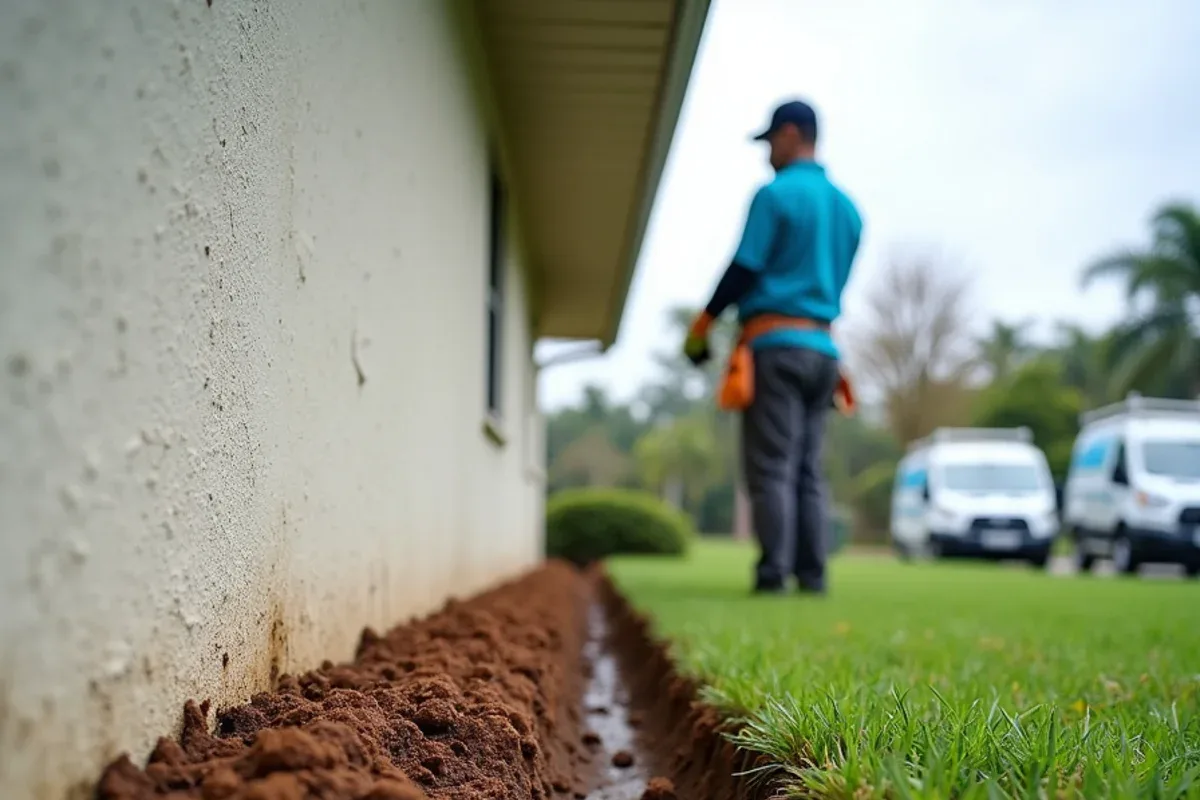
Stand at a corner during a storm and watch the eave. The water does not trickle; it pours in a curtain about where the roof edge sits overhead. On sandy South Florida soil that curtain digs a shallow trench, scatters mulch onto the lawn and splashes grit back onto the wall.
Over a season the trench deepens and starts to tilt water toward the house instead of away. Beds lose their edging, ground cover thins along a sharp line, and shrubs near the eave sit in soil that floods and then bakes. A gutter removes the curtain entirely. That alone is the most visible change after an install.
Zone 2: slab foundation water and the base of the wall
Most South Florida homes sit on a concrete slab on grade, often with block walls finished in stucco. That construction holds up well, but its edge is where problems start. Soil that stays wet against the slab for days at a time does a few things:
- Attracts subterranean termites, which favor moist soil and can travel up through cracks and along the slab edge.
- Wicks moisture into the bottom course of stucco, which shows up as dark staining, peeling paint and mildew.
- Softens the soil under walkways, AC pads and patio slabs that butt against the house, so they settle and pull away.
- Keeps the area under any interior flooring along exterior walls more humid than it should be.
None of that is dramatic in a single summer. It is the slow kind of damage that shows up when you repaint or sell.
Zone 3: why pavers are sinking at the downspout
Paver driveways and patios are everywhere in newer South Florida subdivisions, and they are especially vulnerable. Pavers sit on a bed of sand over a compacted base. Water poured onto one spot, again and again, finds the joints, carries the sand away and leaves a dip.
If you see a bowl forming in the pavers right below a downspout, the downspout is the cause. Resetting the pavers without moving the water just restarts the clock. The fix is to extend the discharge past the pavers, pipe it under them to a lawn outlet, or move the downspout to a corner that drains onto soil.
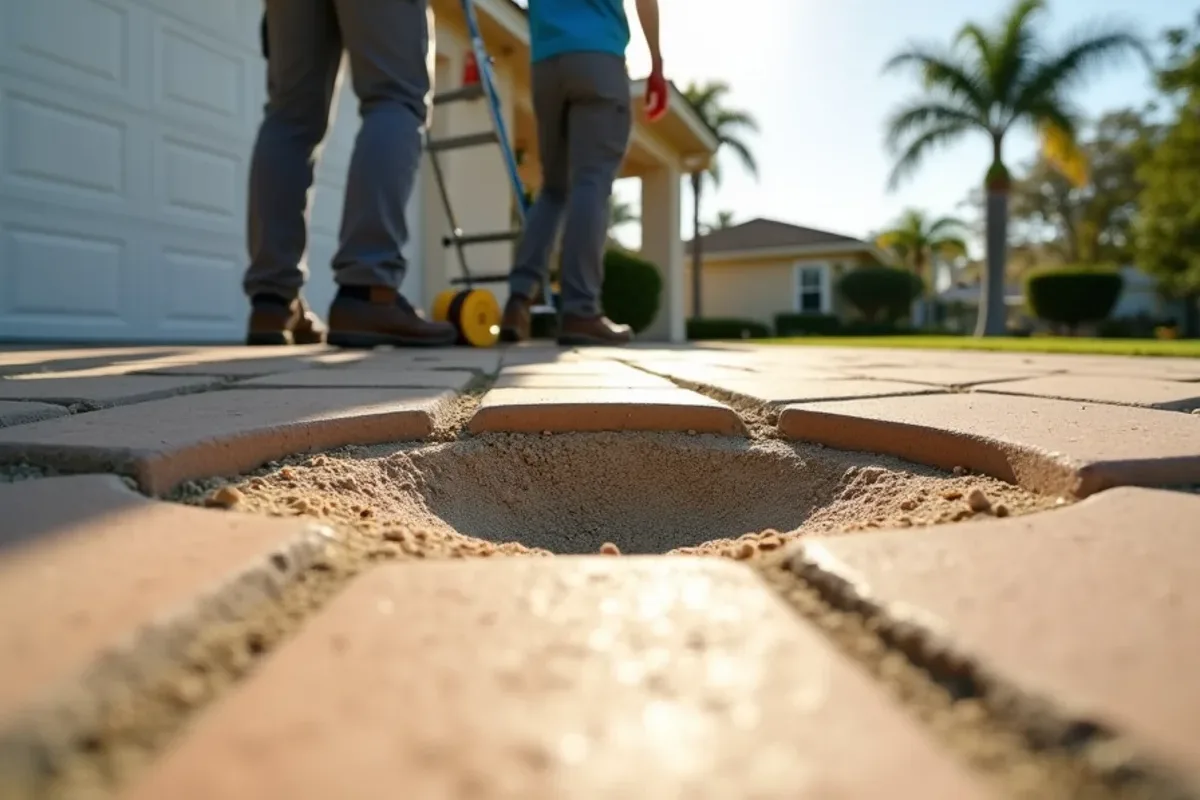
We see this pattern often in the paver-heavy neighborhoods of Pembroke Pines and Miramar, where many homes built from the 1990s on have paver drives that run right up to the garage corner downspout.
Landscape drainage symptoms and what they point to
| Symptom | Likely cause | Typical fix |
|---|---|---|
| Trench in mulch along the house | No gutter, or a gutter overflowing at that run | Install or clean gutter; check pitch |
| Dark band on lower stucco | Splash-back from the drip line or a short elbow | Gutter plus a downspout extension |
| Pavers dipping near one corner | Downspout dumping onto pavers | Extend, pipe under or relocate the downspout |
| Bare soil fan below a downspout | Concentrated flow with no splash block | Splash block, rock pad or buried line |
| Standing water by the AC pad | Discharge aimed at the pad or a low spot | Redirect the extension; regrade lightly |
| Plants dying in one bed only | Bed floods from a nearby outlet | Split the flow or move the outlet |
Zone 4: where downspouts send the water next
Gutters collect the water; downspouts decide where the damage does or does not happen. A gutter system with four downspouts that each end in a short elbow at the wall has taken a long, gentle problem and turned it into four concentrated ones.
Good routing looks like this: each downspout carries its share of the roof to an extension, splash block or buried line that releases it on ground sloping away from the house, past beds and hardscape, toward the lawn, swale or a designed low area. Our downspouts and drainage work covers that last stretch, from simple extensions to buried lines that carry water under a paver drive.
Quick test after the next storm
Walk the perimeter an hour after heavy rain. Any spot within a few feet of the wall that is still puddled tells you which downspout or gutter run to look at first.
Do I need gutters in Florida if my soil is sandy?
Sandy soil does drain fast, which is why some South Florida homes were built without gutters. But fast-draining sand is also easy to wash away, and the issues above have little to do with how quickly the ground absorbs water. If your house has beds, pavers, walkways or a patio close to the walls, or wide eaves are not enough to keep splash off the stucco, gutters are worth it.
A properly sized seamless gutter installation with outlets placed to suit the yard, not just the roof, is how we approach it. Sometimes the right answer is gutters on two sides only, where the beds and pavers are, and nothing on a side that drains to open lawn.
What we notice walking yards before a gutter install
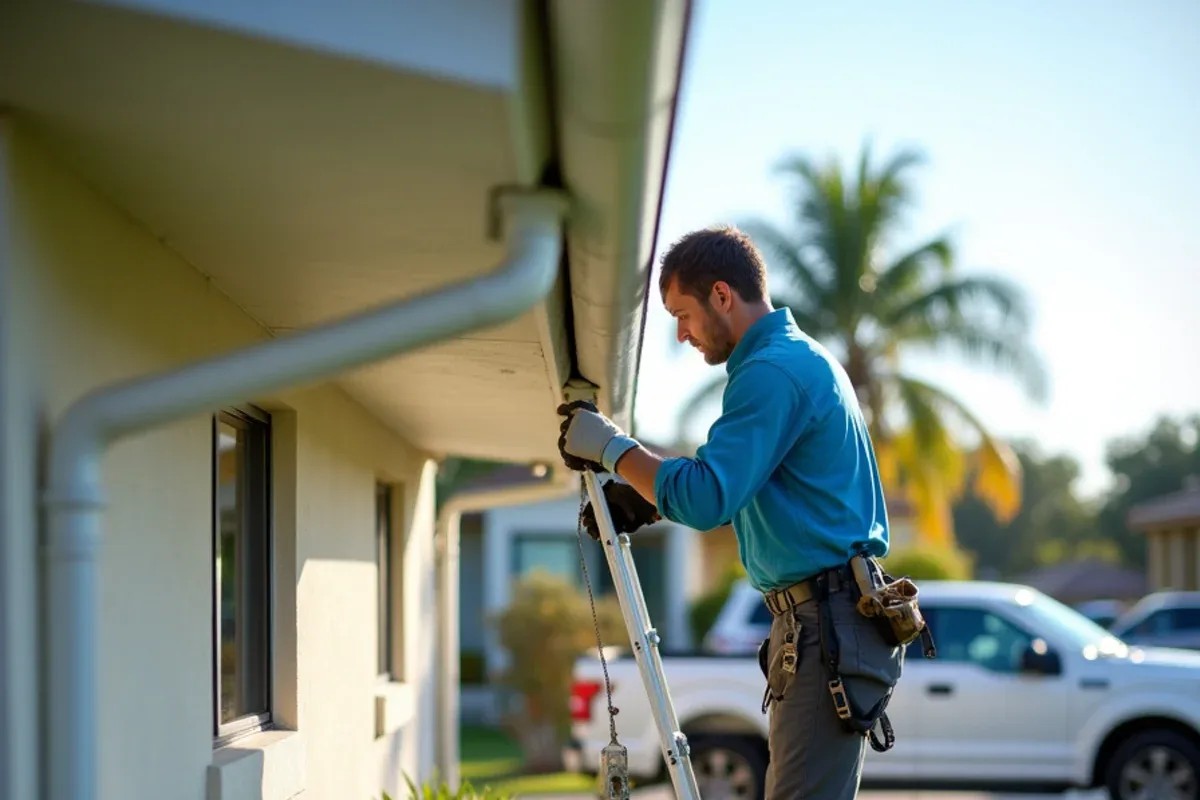
Before we quote gutters, we walk the whole perimeter, and the yard usually tells the story faster than the roof. The most common find is mulch and soil built up over years of bed refreshes until it covers the bottom inch or two of stucco. That hides the slab edge, holds moisture against the wall and makes a termite inspector’s job harder.
The second is water from two directions. A sprinkler head aimed at the wall plus a downspout elbow beside it keeps the same strip of soil wet nearly every day, and homeowners blame the gutter for both. Turning the irrigation head is free; fixing the downspout is our part.
Florida’s own guidance lines up with what we see. Termite material from the Florida Department of Agriculture and Consumer Services points out that sandy soils are why many older Florida homes were built without gutters, and it recommends sloping the yard away from the house and adding gutters with extensions. Gutters do not seal a slab, though. Termites can still come up through gaps around plumbing, so inspections and treatment remain a separate job.
A 15-minute walk-around you can do yourself
- Look at the bottom of the stucco on every side: you should see the slab edge or a clean line above the soil, not mulch piled against paint.
- Find each downspout and note what it lands on: lawn, bed, pavers, walkway or AC pad.
- Press a heel into the soil a foot from the wall a day after rain; soft, wet sand there means water is lingering.
- Check paver edges and walk joints near each corner for dips or open sand gaps.
- Watch the sprinklers run once and note any head that hits the wall.
- Photograph anything odd so you can compare it next season.
The honest trade-off: full gutters on every side cost more than a partial system, but partial gutters only work if the uncovered sides drain to open lawn. Where beds or pavers run along a wall, that wall needs a gutter.
Keeping water off the slab and in the right part of the yard
Roof water does its damage where it lands. Gutters move that landing spot from the drip line to a few downspouts, and good routing moves it again, out past beds, pavers and the slab edge to ground that can take it. Get both halves right and the mulch stays put, the pavers stay level and the stucco stays clean.
If your yard is showing any of the signs in the table above, call Southern Gutters FL for a free estimate. We will walk the perimeter with you and quote gutters, downspout routing or both, whichever the house actually needs.
Questions about gutters protect foundation
Can gutters stop pavers from sinking?
They help only if the downspouts do not discharge onto the pavers. If a downspout already dumps on the paver edge, extending it, piping it under the pavers to a lawn outlet or moving it to a different corner stops the sand washout so the pavers can be reset for good.
Do gutters help with termites?
Indirectly. Subterranean termites favor moist soil, and gutters with good downspout routing keep the soil along the slab drier. They are not a substitute for a termite inspection or treatment program, but they remove one condition termites like.
Can a lack of gutters cause foundation problems in Florida?
Rarely the structural cracking people fear from northern basements. On a South Florida slab, missing gutters more often cause trenches along the drip line, soil that stays wet at the slab edge, stucco staining and settling walkways or AC pads. Those conditions invite termites and slow damage, which is why we treat gutters and downspout routing as foundation protection.
Will gutters fix standing water in my yard?
Only if roof water is the source. Watch the yard during a storm from a dry spot: if the puddle forms below a downspout or drip line, gutters and better routing will fix it. If water collects in the middle of the lawn from a neighbor’s slope or a high water table, the answer is grading or yard drainage, not gutters.
Services mentioned in this guide
Downspouts & Drainage
Downspouts sized, placed and routed so roof water clears your slab, patio and the neighbor's yard.
Learn moreSeamless Gutter Installation
Aluminum gutters roll-formed on site to each wall’s length, hung on stainless hardware, with a 3-year/20-year warranty.
Learn moreServing Pembroke Pines, Miramar and the rest of South Florida.