
By Chance, owner of Southern Gutters FL · Published · Last updated
Key takeaways
- Many South Florida houses without gutters were built that way to save cost, not because gutters are useless here.
- The clearest reasons to add gutters are water pouring onto doorways, patios, walkways or a neighbor’s yard.
- Sandy soil absorbs water fast, but repeated splashback still stains stucco and washes out beds.
- Partial gutters over entries and problem sides are often the smart middle ground.
- Wide overhangs and a yard that slopes away can make gutters optional.
Not every Florida house needs gutters, but most need them somewhere. Add them wherever roof water lands on a door, patio, walkway, stucco wall or a neighbor’s yard. A home with two-foot overhangs, sandy soil and a lot that slopes away can do fine without them. One rainy-season walk-around usually settles it.
Drive through almost any 1950s or 1960s neighborhood in Broward or northern Miami-Dade and you will see block homes with no gutters at all. They have stood for sixty years, so it is fair to ask: do I need gutters in Florida, or is this something a salesperson invented?
The honest answer is that some houses do fine without them and some quietly suffer. We sell gutters, so take this with that in mind, but we also turn down jobs where gutters would add maintenance without solving anything. Below is how we sort one from the other.
Why so many houses without gutters in Florida look fine
Post-war builders in South Florida worked fast and cheap. Concrete block walls, a slab on grade, a low hip roof and a modest overhang were standard. Gutters were an add-on, and many buyers skipped them. Sandy soil and flat lots helped hide the consequences, because water soaks in quickly instead of pooling for days the way it does on clay.
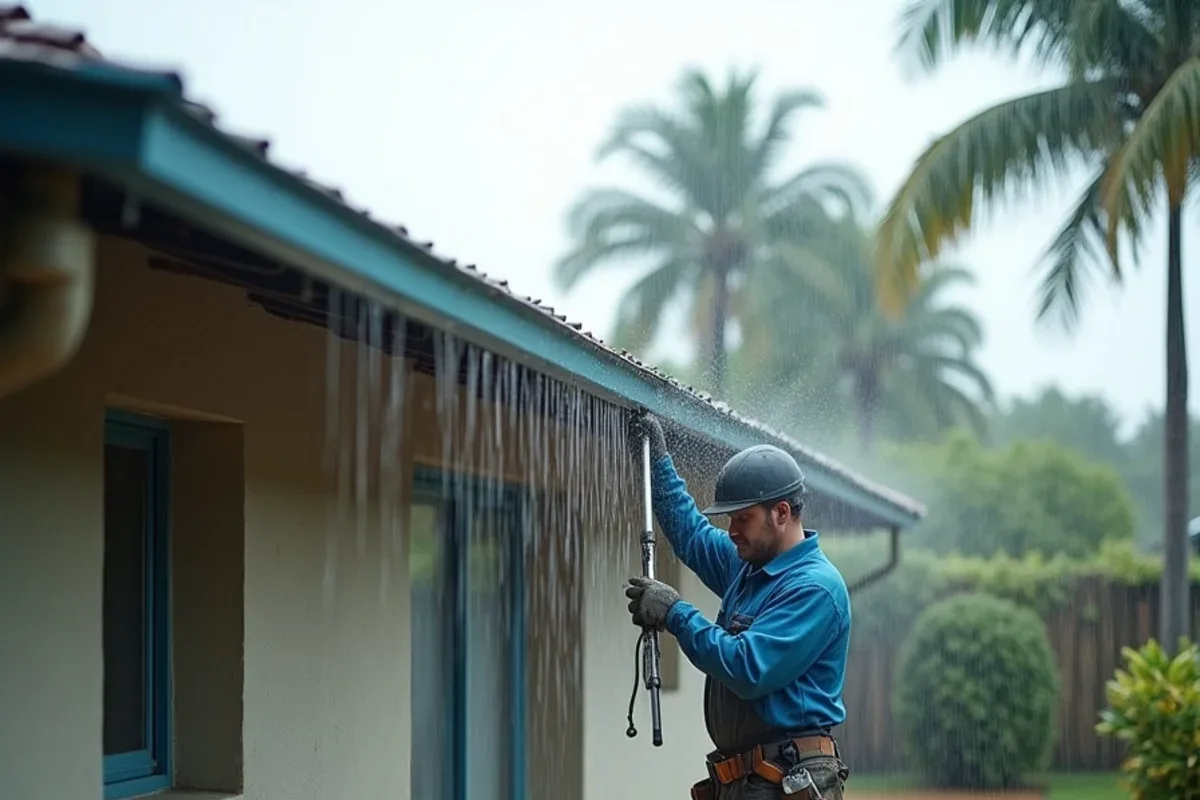
That does not mean the water disappears harmlessly. On a typical CBS house, a summer cloudburst can drop more rain in an hour than the ground can take at the drip line. Without a gutter, all of it comes off the roof edge in a sheet and lands in the same narrow strip around the house, every storm, for decades.
What roof runoff does to a CBS house over time
We rarely see dramatic foundation failure from missing gutters on a slab home. The damage is slower and more annoying.
- Stucco splashback. Rain hitting soil or pavers throws grit and organic matter up the wall, leaving a dark band along the base that turns green in shady corners.
- Washed-out beds. A trench forms under the roof edge, exposing roots and burying mulch in the lawn.
- Wet entries. Front doors, sliding glass doors and garage thresholds take a direct pour, which wears weather-stripping and sends water inside during wind-driven storms.
- Settling pavers. Concentrated water under a drip line undermines paver bases and walkways.
- Neighbor disputes. On tight lots, a side roof can dump straight onto the property line.
Hurricane season adds one more angle. Wind-driven rain pushes water sideways under sliding door tracks and through gaps around older windows, and a roof edge dumping directly onto that opening makes it worse. A gutter will not stop a tropical storm, but it removes the extra water you control.
If you are seeing two or more of these, gutters are probably worth it. If you see none after a full rainy season, you may be one of the houses that genuinely does fine without them.
Are gutters necessary on your house? A quick decision table
| What you see at your house | Our usual advice | Why |
|---|---|---|
| Roof edge pours onto a door, patio or walkway | Add gutters, at least there | People walk through it and water gets inside |
| Dark splash band on stucco and eroded beds | Add gutters on those sides | Damage repeats every storm |
| Side roof drains toward a neighbor 10 feet away | Add a gutter and route the downspout | Keeps water on your lot |
| Overhang of two feet or more, lawn slopes away | Gutters optional | Water already lands clear of the house |
| Flat roof with scuppers | Leader heads and downspouts, not full gutters | Scuppers concentrate water at one point |
| Heavy tree cover and no time for upkeep | Partial gutters with guards, or none | Clogged gutters can be worse than no gutters |
The middle ground: partial gutters where water causes trouble
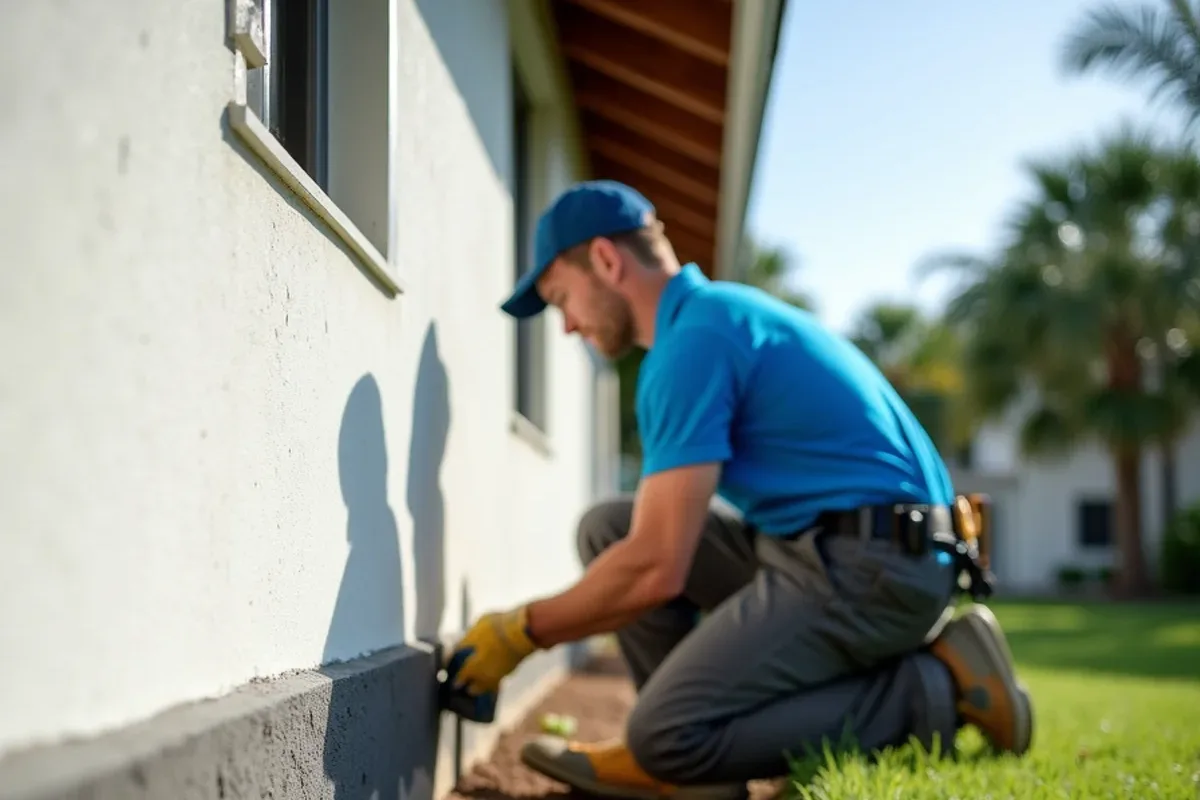
You do not have to wrap the whole roof. A lot of our work on older homes is two or three short runs: one over the front entry, one over the back patio slider, one on the narrow side yard. Each gets its own downspout, discharged onto a splash block or piped to the swale.
This approach solves the problem spots without adding gutters along a back wall where nothing but lawn sits below. It also keeps cleaning simple. On homes under black olives or ficus, fewer feet of gutter means fewer feet to keep clear.
A warning about half-measures
A gutter that ends at the corner of a patio with no downspout simply moves the waterfall a few feet. Every run needs a planned exit.
Adding gutters to a CBS house: what the job involves
Gutters hang from the fascia board, so the first thing we check on an older block home is the fascia itself. Decades of runoff often leave the lower edge soft. Rotten sections get replaced before anything is hung.
From there, we measure each side, choose a size (most homes take 5-inch or 6-inch K-style), plan outlet locations so downspouts land where water can drain away, and roll-form seamless runs on site in a color that suits the trim. Our seamless gutter installation page explains materials and color options in more detail, and installs carry our 3-year workmanship and 20-year materials warranty.
This is a common job in neighborhoods like West Park, where many 1950s–60s block homes never had gutters, and in Miami Gardens, where CBS houses from the Carol City era have often been reroofed several times without anyone thinking about the water coming off the edge.
What we look for when we walk a house with no gutters
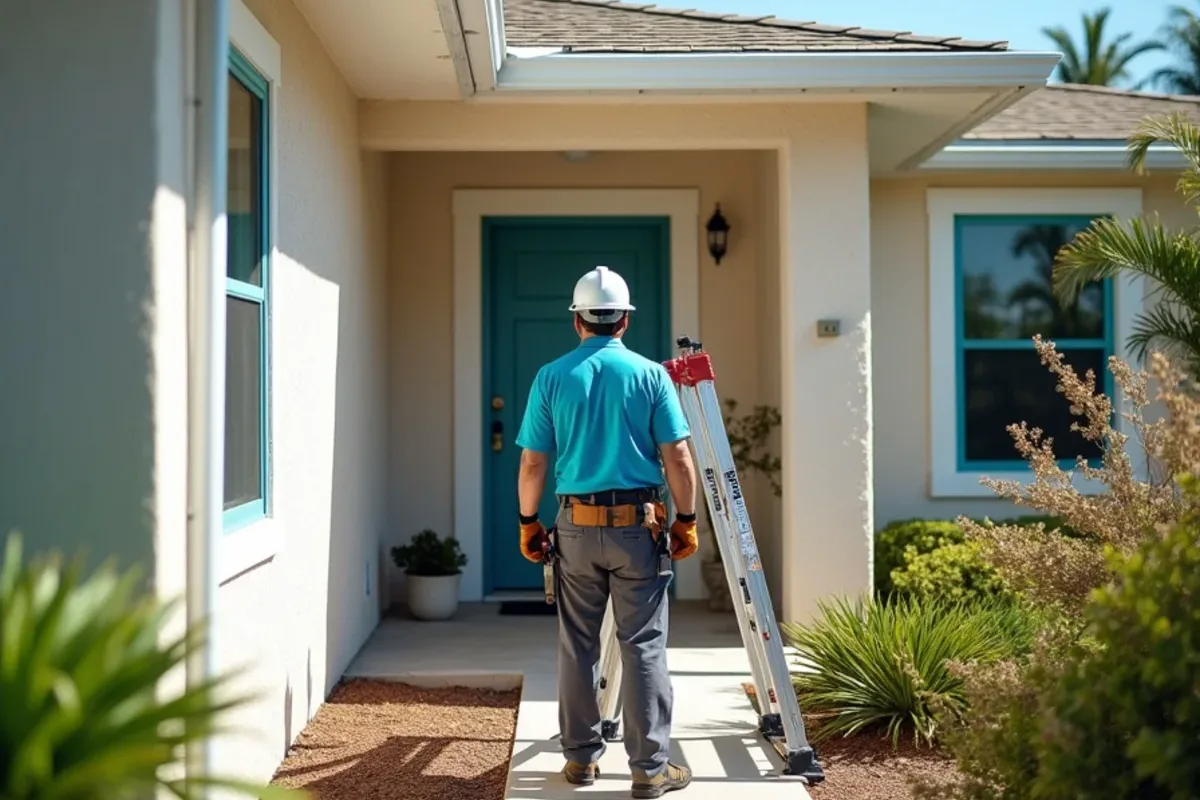
Most of the evidence is already on the house. We start at the base of the walls, not the roof. A gray-green band on the lowest foot of stucco, sand washed into the paver joints, a rusty streak under the AC pad and a soft lower edge on the fascia all point to the same few feet of roof edge.
The trade-off we explain on every visit: a gutter moves the water, it does not make it vanish. Every downspout needs a place to let go, whether that is a splash block, an extension to the lawn or a line to the swale. A gutter added without that plan just turns a long sheet of water into one hard stream in the wrong spot. And under black olives or ficus, a gutter nobody cleans will overflow right where you wanted it dry.
A rain-day walk-around you can do yourself
- Wait for a real afternoon storm, not a drizzle, and walk the outside of the house under an umbrella.
- Stop at every door and slider. Note which ones take a direct pour from the roof edge.
- Watch where the sheet of water lands: soil, pavers, the AC pad or the neighbor’s side.
- After the storm, look for puddles that are still there an hour later.
- Mark each problem spot on a simple sketch of the house. Those marks are where gutters belong.
If the sketch shows two or three marks, partial runs will probably do. If it shows trouble on every side, a full system with planned discharge points makes more sense.
Building or adding on? Plan the gutters now
If you are building a new home or adding a room, decide on gutters before the stucco and landscape go in. Downspout locations, underground drain lines and splash areas are far easier to plan around open ground than to retrofit. Builders sometimes treat gutters as an optional extra; our new construction gutters service works with your builder’s schedule so the system is designed with the grading, not bolted on after.
If you are still unsure about your own house, ask for a free estimate. We will walk it with you in the rain-stained areas and tell you plainly if a gutter would help, or if you are better off without one.
So, does your house need gutters?
Plenty of older block homes in South Florida get by without gutters, and some of them always will. The ones that do not are easy to spot once you know the signs: stained stucco, trenches in the beds, wet thresholds and water headed for the property line. Fix those spots first, plan where each downspout drains, and skip gutters where nothing below needs protecting.
If you would rather have a second set of eyes on it, call Southern Gutters FL for a free estimate. We will tell you where gutters earn their keep on your house and where they do not.
Questions about do i need gutters in florida
Will gutters cause mold or mosquitoes in Florida?
Only if they hold water. Properly pitched, clean gutters drain within minutes after rain. Sagging runs and clogged outlets are what breed mosquitoes, which is why pitch, outlet size and a realistic cleaning plan matter as much as the gutters themselves.
Do I need gutters on a flat-roof home?
Usually not full-length gutters. Flat roofs drain through scuppers in the parapet, and the fix is typically a leader head and downspout at each scupper so water does not pour down the wall or onto a walkway.
Are gutters worth adding before I sell the house?
They can be. Buyers and home inspectors notice splash-stained stucco, washed-out beds and soft fascia, and those are easier to explain away when the cause is already fixed. A few well-placed runs over entries and problem sides often do more for a listing than wrapping the whole roof.
Are gutters required by code on a Florida home?
Usually not. The Florida Building Code generally leaves gutters optional on a typical single-family house and focuses on how the roof itself is built and attached. Requirements tend to come from elsewhere: an HOA’s architectural rules, a builder’s drainage plan, or a site plan that says where roof water must go. If you are in an HOA, check its guidelines before adding or removing gutters.
Services mentioned in this guide
Seamless Gutter Installation
Aluminum gutters roll-formed on site to each wall’s length, hung on stainless hardware, with a 3-year/20-year warranty.
Learn moreNew Construction Gutters
Seamless gutters for new builds and just-closed homes, timed around roof finals, HOA approval and landscaping.
Learn moreServing West Park, Miami Gardens and the rest of South Florida.